Wednesday, November 5, 2014

New York State History Month: New York City Scenes on Transferware

Did you know that November is New York State History Month? To mark this occasion, Alice News will be highlighting pieces of transferware from the Alice’s collection that feature New York’s history and scenery. We’ll start in New York City, then move into the Hudson Valley and the Catskill Mountains, and end our journey out west in Buffalo and Niagara Falls.

Patriotic Americans in the years after the War of 1812 could choose from a wide variety of ceramics that depicted national heroes, military victories, public buildings, scenery, and important happenings, such as the opening of the Erie Canal. Most of these pieces were made in England, in the Staffordshire District. The potteries used the transfer process to create these American commemoratives. The design would be engraved on a copper plate, much like those used for making paper engravings. The plate was used to print the pattern on tissue paper, then the tissue paper transferred the wet ink to the ceramic surface. The ceramic was then fired in a low temperature kiln to fix the pattern. This method was a much less costly alternative to hand-painting, making these ceramics accessible to a wide range of Americans.


J. and W. Ridgway, New York City Hall
Our first piece is a dinner plate that shows New York’s City Hall. This plate is part of a series illustrating the “Beauties of America,” made by the English pottery company of John and William Ridgway. John Ridgway came to the United States in 1822, and traveled throughout the eastern states in search of suitable views of major American cities, as well as to establish business relationships with American ceramic merchants. Ridgway selected 22 buildings, including almshouses, hospitals, churches, and banks, to feature on a wide range of tableware—tureens, platters, gravy boats, tea sets, dinner plates, soup bowls, even a baby’s bathtub!


Ridgway chose just two New York places for the Beauties of America: the Almshouse (later Bellevue Hospital) and City Hall. The building depicted here was actually New York’s third City Hall. The first one was built by the Dutch in the 17th century on Pearl Street, the second in 1700 on Wall and Nassau Streets. That building was renamed Federal Hall when New York became the capital of the United States in 1789. The City Council chose the site for a new City Hall on the old Common at the northern limits of the city, and held a competition to design a new building in 1802. The prize was awarded to Joseph-François Mangin and John McComb, Jr. Disagreements over the design and costs, labor disputes, and a yellow fever outbreak delayed construction, but the building finally opened officially in 1812. 


City Hall in 1919
City Hall was designated a National Historic Landmark in 1960. Parks Service historian Charles E. Shedd, Jr., in his report for the National Survey of Historic Sites and Buildings, summed up its importance:

“Since its completion in 1811, New York City Hall has been the heartbeat of the bustling seaport which became the capital of the Free World. The Hall has watched American armies passing in review, going to battle or coming home from the Nation’s wars, from 1812 to Korea. For more than a century and a half it has greeted the great of this and other nations; Lafayette and Lindbergh, Garibaldi and Eisenhower; and it has welcomed to these shores the humble and unknown. Before it have passed generations of immigrants, trudging toward their new homes in the teeming city or in the cities, farms, and plains which stretched westward to the Pacific. The Hall tells the colorful and significant story of civic administration in an American metropolis and preserves the deeds of good men and bad who shaped the American political tradition: DeWitt Clinton, father of the Erie Canal; ‘Boss’ Tweed, the evil genius of machine politics, and the able and flamboyant ‘Little Flower,’ Fiorello La Guardia, among scores of others no less memorable.”


James and Ralph Clews, Landing of Gen. Lafayette
Shedd’s mention of Lafayette brings us to our second item: Pieces depicting General Lafayette’s arrival at Castle Garden on August 16, 1824, made by James and Ralph Clews. I’ve chosen a platter as illustration so you can get a good look at the image; the Alice’s collection includes a pitcher, large washbasin, and a plate. It’s hard to express just how important Lafayette’s visit was, and how absolutely wild Americans were about him. Lafayette was the last surviving general of the Revolutionary War—he had first come to the colonies as a 19-year-old, and now, almost 40 years later, he was back. 1824 was also a presidential election year, and the first one in which none of the members of the old Revolutionary generation was a candidate. During this time of change, Americans joyfully looked back to the heroes of the Revolutionary era.


Lafayette as a young lieutenant general, 1791
Lafayette traveled to the U.S. on the American merchant vessel Cadmus, along with his son, George Washington Lafayette, and secretary, Auguste Levasseur. When the ship arrived in New York Harbor, it was met by two steamboats, the Chancellor Livingston and the Robert Fulton, and escorted with great fanfare to Castle Garden.

Castle Garden had originally been built as a fort, known as the West Battery, on the southern tip of Manhattan. Troops were stationed there during the War of 1812, though it saw no action. It was renamed Castle Clinton in 1815, in honor of New York State’s first governor, George Clinton. However, the army abandoned it in 1821, and by the time of Lafayette’s visit, it had become a place of public amusement, offering concerts, a beer garden, and other entertainments.

Castle Garden was the site of one of the massive public receptions held for General Lafayette during his American tour. The author of the book Memoirs of General Lafayette, published in 1824, described the occasion:

“The most splendid scene exhibited in this proud city, was the fete at Castle-garden. This was an evening party and ball, at which six thousand ladies and gentlemen were present. It was the most brilliant and magnificent scene ever witnessed in the United States. Castle-garden lies at a very short distance from Battery-street, which is a spacious and elegant promenade, on the south westerly part of the city. It was formerly a fort and is about one hundred and seventy feet in diameter, of a circular or elliptical form. It has lately become a place of great resort in the warm season of the year. Every thing which labor and expence, art and taste could effect was done to render it convenient, showy and elegant. An awning covered the whole area of the garden, suspended at an altitude of seventy-five feet; the columns which supported the dome were highly ornamented, and lighted by an immense cut glass chandelier, with thirteen smaller ones appended.


Perhaps some of the ladies at the fete wore
commemorative gloves like this pair in the Alice’s collection.
“The General, made his appearance about 10 o’clock, when the dance and the song was at an end. The military band struck up a grand march, and the Guest was conducted through a column of ladies and gentlemen to a splendid pavilion. Not a word was spoken of gratulation—so profound, and respectful, and intellectual was the interest which his presence excited....In front of the pavilion was a triumphal arch, of about 90 feet span, adorned with laurel, oak, and festoons, based upon pillars of cannon fifteen feet high.—A bust of Washington, supported by a golden eagle, was placed over the arch as the presiding deity. Within the arch was a symbolic painting nearly 25 feet square, exhibiting a scroll inscribed to Fayette, with the words:—‘Honored be the faithful Patriot.’

“Soon after the General entered, the painting just alluded to was slowly raised, which exhibited to the audience a beautiful transparency, representing La Grange, the mansion of La Fayette. The effect was as complete as the view was unexpected and imposing. Another subdued clap of admiration followed this tasteful and appropriate and highly interesting display.”


Castle Garden in its Aquarium days, early 1900s
Though this was undoubtedly a highlight of its existence, Castle Garden went on to have a long and varied life. In 1855, it became the Emigrant Landing Depot, New York State’s first immigrant processing facility, and served this purpose until Ellis Island opened in 1890. Over 8 million immigrants (and maybe as many as 12 million) passed through Castle Garden. Between 1896 and 1941, it was the site of the New York City Aquarium. It was designated a national monument in 1946, and is once again known as Castle Clinton.

If you are interested in learning more about American historical Staffordshire, Patriotic America, a site created by the Transferware Collectors Club, Winterthur Museum, and Historic New England, is a great place to start!


Friday, October 31, 2014

H. P. Lovecraft and the Colonial Revival

Today’s Halloween-themed post is brought to you by guest blogger Joshua Beatty. Joshua is a historian of colonial America and a librarian at SUNY Plattsburgh, and an aficionado of unspeakable eldritch horrors. You can read more of his writing here.


He was in the changeless, legend-haunted city of Arkham, with its clustering gambrel roofs that sway and sag over attics where witches hid from the King’s men in the dark, olden years of the Province. Nor was any spot in that city more steeped in macabre memory than the gable room which harboured him – for it was this house and this room which had likewise harboured old Keziah Mason, whose flight from Salem Gaol at the last no one was ever able to explain.— H. P. Lovecraft, “The Dreams in the Witch-House”
H. P. Lovecraft in 1934
Today is Halloween, a day which we associate with ghosts and goblins and all manner of frightful things — including, yes, witches. Few have written so vividly about such horrors as H. P. Lovecraft. But what isn’t as well known is the common interest he shared with Alice Miner – that of America’s colonial era.
Howard Phillips Lovecraft was born in 1890 in Providence, Rhode Island. He lived in that city for most of his life, and he loved nothing more than the colonial buildings that in the early twentieth century still dominated much of the city. “I am above all scenic and architectural in my tastes” he explained to a friend. And with an exuberance he reserved for landscape and architecture, a Lovecraft stand-in returning after a long journey in “The Case of Charles Dexter Ward” described it thus:
At the high square where Broad, Weybosset, and Empire Streets join, he saw before and below him in the fire of sunset the pleasant, remembered houses and domes and steeples of the old town; and his head swam curiously as the vehicle rolled down to the terminal behind the Biltmore, bringing into view the great dome and soft, roof-pierced greenery of the ancient hill across the river, and the tall colonial spire of the First Baptist Church limned pink in the magic evening against the fresh springtime verdure of its precipitous background.


First Baptist Church, early 20th c.
Lovecraft did not confine his interest in colonial landscapes to Providence. He traveled widely up and down the eastern half of the North American continent, from Key West in the south all the way to Quebec City in the north and as far west as New Orleans and Cleveland. Lovecraft was constantly writing on these trips. Letters to friends and travelogues both contained detailed descriptions and histories and even sketches of the architecture he viewed. These writings culminated in a 75,000-word opus on a single city, “A Description of the Town of Quebeck in New-France, Lately added to his Britannick Majesty’s Dominions.”


That title, with its purposefully archaic grammar and spelling, reflects Lovecraft’s wish to insert himself into the times and places he so romanticized. Unsurprisingly, then, Lovecraft strongly approved of the efforts to restore colonial buildings that took place throughout the Colonial Revival period. On a visit to Williamsburg, Virginia, he concluded “I must revisit Williamsburg when the restorations are compleat, perhaps two to five years hence. It will then form, without doubt, one of the most impressive evocations of the colonial past that America can display.”


Map of Arkham, Massachusetts, the fictional town where
Lovecraft set many of his tales
Lovecraft’s passion for colonial architecture would hardly be relevant to Halloween, were it not that those same colonial buildings were integral parts of his horror stories. Where the horror writers of the nineteenth century, from Shelley to Poe, used Gothic architecture to evoke an atmosphere of fear and gloom, Lovecraft used instead the familiar landscapes of his own New England.
The Crowninshield House in “The Thing on the Doorstep”
was modeled on this house in Salem.
One can’t read Lovecraft’s work without being shocked by his virulent racism. This racism was often symbolized in his work by architecture. The upright descendents of English settlers make their homes in stately colonial mansions or sturdy, well-kept farmhouses. In contrast, African-Americans, American Indians, or the “decayed branches” of white colonial families live in decrepit shacks or tenement houses.
The “Witch House” in Salem, home of Judge Jonathan
Corwin in the 17th century.


Yet the worst situation of all was when when a good colonial house was occupied by inferior peoples. In “The Dreams in the Witch-House,” the seventeenth-century building of the title has been rented to a motley collection of Italians, Poles, and even French-Canadians. When a college student with an old English colonial name, Walter Gilman, becomes fascinated by “the hushed Arkham whispers about Keziah’s persistent presence in the old house and the narrow streets,… about the childish cries heard near May-Eve, and Hallowmass” and takes a room, the tropes of horror fiction already suggest the ending.
Sources:
Evans, Timothy H. “A Last Defense against the Dark: Folklore, Horror, and the Uses of Tradition in the Works of H. P. Lovecraft.” Journal of Folklore Research 42, no. 1 (January 1, 2005): 99–135.
Lovecraft, H. P. Collected Essays, Volume 4: Travel. Edited by S. T Joshi. New York: Hippocampus Press, 2005.


Guides to visiting places that appear in Lovecraft’s work (if you dare):


Friday, October 24, 2014

“In the Brave Days of Old”: Wallace Nutting’s Colonial America

“In the Brave Days of Old”
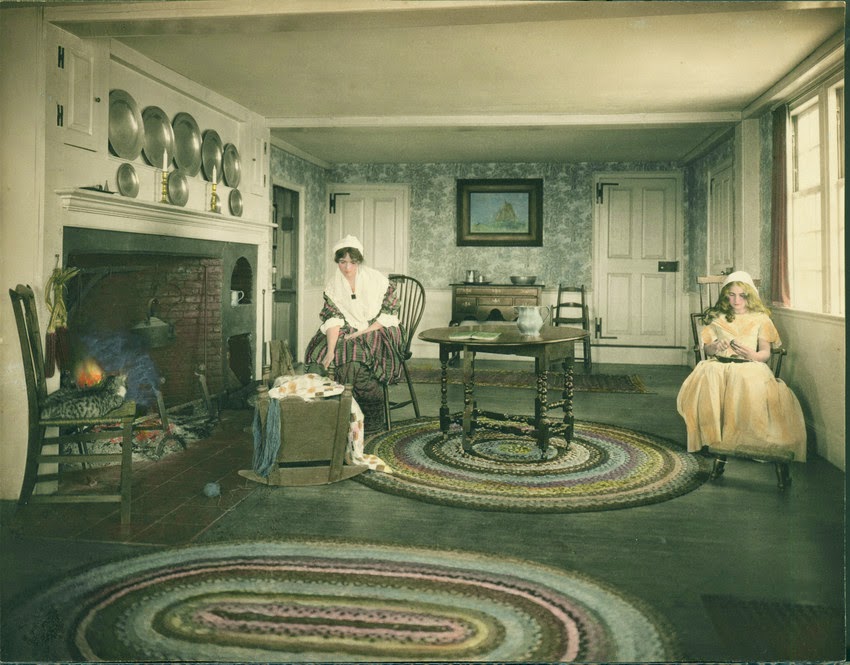
In the Miner Room on the third floor of the Alice, there are two photographs that look like they could have been taken in the Museum. One shows a woman descending an elegant staircase, and the other a woman stirring a pot over an open fire. Both photos are the work of Wallace Nutting, the man who perhaps did more than any other individual to popularize the Colonial Revival. Nutting’s vision of “Old America,” transmitted through historic homes, reproduction furniture, and most of all, photography, shaped the way Americans in the early 20th century envisioned the colonial past.
“The Elaborate Dinner”

Wallace Nutting was born in 1861 in Rockbottom, Massachusetts and enrolled at Harvard in 1883. During the summers he worked in hotels at various popular resorts in New England—Campobello Island, Martha’s Vineyard, Nantucket—that he would later return to as a photographer. After graduating from Harvard, he went on to Hartford Theological Seminary and Union Theological Seminary, becoming a Congregational minister in pulpits around New England.

In the early 1900s, however, Nutting began to suffer from neurasthenia--a disease peculiar to the Victorian era, characterized by fatigue, anxiety, and weakness, and thought to be caused by the stresses and strains of modern urban life. He left the church for good in 1904, and he and his wife, Mariet, purchased a derelict farm in Southbury, Connecticut. Nutting had been a dedicated amateur photographer since his college days, and photography was in fact often recommended as therapy for neurasthenia, because it combined artistic pursuit with healthful outdoor activity. He now turned to photography as a means of supplementing his income.
One of the many versions of “Cherry Blossoms”

The subjects of Nutting’s photos were almost exclusively rural, and rarely showed any indications of modernity. Pastoral fields of cows, country lanes, blossoming trees, and old barns were some of his favorite subjects. These scenes of an unspecified but clearly pre-industrial era were enormously appealing to middle-class urban dwellers.

Between 1905 and 1912, Nutting (with Mariet’s assistance) perfected a system for producing high-quality colored photographs on a large scale. The photos were printed using the platinotype process and then tinted with watercolors, following a model, by a carefully-trained staff of young women. Nutting produced his first catalog in around 1910; it depicted over 500 photos and noted that many more were available. Prices ranged from $1.25 for the smallest pieces (5” x 7”) up to $20.00 for the largest (20” x 40”)—well within the reach of most middle-class consumers.
A typical Nutting colonial vignette

While the outdoor views made up the bulk of the catalog, it was Nutting’s colonial interiors that were the most popular. By 1911 he was offering about 200 different interior scenes, which accounted for about a quarter of his total picture sales. Mariet Nutting had first suggested staging scenes with models—usually the young women who worked as colorists—to create “period vignettes.” 

Though Nutting was producing his photos in the age of the “new woman,” the suffragette, and the flapper, his pictures showed women in decidedly traditional roles. Either they were shown engaged in genteel leisure activities—reading, writing letters, drinking tea—or in productive (but still genteel) work—spinning, sewing, cooking. In a time when gender roles were rapidly changing, Nutting’s pictures offered a reassuring vision of the past.

In order to make sure that the settings in his photographs were authentic, Nutting began to collect furniture, rugs, costumes, and other items that could be used as props. Then, to ensure that he always had suitable backgrounds, he began to purchase the historic properties which eventually would become the Wallace Nutting Chain of Colonial Picture Houses. The five houses, purchased and restored between 1914 and 1916, included the Joseph Webb House in Wethersfield, Connecticut; the Wentworth Gardner House in Portsmouth, New Hampshire; the Hazen Garrison House in Haverhill, Massachusetts; the Cutler-Bartlett House in Newburyport, Massachusetts; and the Ironmaster’s House in Saugus, Massachusetts. 

17th-century cupboard made by Wallace Nutting
As a financial investment, the houses never lived up to Nutting’s hopes, because their opening coincided with the first World War and the imposition of gasoline rationing, which severely curtailed tourism. But they did help solidify his reputation as an expert on historic architecture and furnishings. Nutting also started to manufacture his own line of reproduction furniture in 1917. He considered the colonial-inspired pieces produced by the big companies to be “humbug furniture,” while his own pieces were worthy of being called the “antiques of tomorrow.” Nutting’s furniture was authentic in appearance, though his workers did use modern construction techniques and machinery.

In addition to all his other ventures, Wallace Nutting was a prolific writer and lecturer. In the 1920s he began writing travel guides, the States Beautiful series, that took readers on virtual tours (illustrated with his own photographs, of course) of the states of the eastern seaboard. He also bolstered his reputation as a furniture expert with three books on the history of American furniture: American Windsors (1917), Furniture of the Pilgrim Century (1924), and Furniture Treasury (3 volumes; 1928 and 1933). Alice owned all of these books on furniture.


Photo by Wallace Nutting taken in the parlor of the Webb House.
Note that the murals depict two of Nutting’s other properties,
the Hazen Garrison House and the Saugus Iron Works.
Although Nutting was convinced of the superiority of the past, he nonetheless was a very modern businessman. Nutting employed an advertising agency beginning in the early 1920s, which produced print campaigns for magazines like Antiques. These advertisements were carefully targeted at middle-class customerspeople who did not have their own family heirlooms that “came over on the Mayflower” but liked to think of themselves as people who should have such fine items. All of his ventures were carefully planned to work together: the historic homes provided settings for his photographs; the books educated consumers about the furniture; and the photographs generated interest in the historic properties and the furniture. 

Above all else, Wallace Nutting saw himself as an educator, one with a very specific moral lesson to impart about the values of rural, pre-industrial America. That this idea owed as much to his imagination as it did to reality was unimportant. Nutting’s vision, combined with shrewd business tactics, tapped into a vein of nostalgia about the past and made him the foremost popularizer of the Colonial Revival in the early 20th century.


Sources:

Thomas Andrew Denenberg, Wallace Nutting and the Invention of Old America (New Haven: Yale University Press, 2003).

Richard Guy Wilson, Shaun Eyring, and Kenny Marotta, Re-Creating the American Past: Essays on the Colonial Revival (Charlottesville: University of Virginia Press, 2006).

Joyce P. Barendsen, “Wallace Nutting, an American Tastemaker: The Pictures and Beyond,” Winterthur Portfolio 18, no. 2/3 (July 1, 1983): 187–212.


Friday, October 17, 2014

The Colonial Revival Heads West

In the years between the Philadelphia Centennial Exposition of 1876 and the Chicago World’s Fair of 1893, interest in and knowledge about early America had grown enormously. In fact, there were more examples of the Colonial Revival on display at the Columbian Exposition than had ever been brought together anywhere before. Moreover, this was the first time that the Colonial Revival had been exhibited extensively outside the eastern seaboard, meaning that for many native midwesterners, as well as foreign immigrants, this was their first exposure to the style.


Pennsylvania State Building
Perhaps the most obvious manifestation of the Colonial Revival were the state buildings. Of the 39 states represented at the Fair, 21 chose to erect colonial-style buildings. Most were loose adaptations of local colonial architecture, while four states chose to adapt or replicate historic structures. Pennsylvania based its building on Independence Hall, Massachusetts on John Hancock's house, New Jersey on George Washington’s headquarters in Morristown, and Virginia on Mount Vernon. 

In explaining the reasons behind Massachusetts’s choice of architectural style, the Board of Managers described its “air of aristocratic distinction and reserve and dignity” while still retaining “a homelike and comfortable appearance.” States wanted their buildings to impress visitors while also presenting a welcoming exterior to fairgoers. Colonial styles, because of their associations with a historic and patriotic period in America’s past, seemed especially appropriate for official buildings.

Massachusetts State Building


Except for Virginia’s building (the only one that was a true replica inside and out), none of the state buildings attempted to recreate an accurate colonial interior. The state buildings had to serve a variety of functions, and needed office space, meeting and reception rooms, and restrooms which could not be accommodated in a colonial floor plan. They did, however, include colonial furniture (some antique, but mostly reproduction), woodwork, and wall and window treatments.


Essex Institute exhibit

Most state buildings also housed exhibits of colonial artifacts, including furniture, textiles, ceramics, and portraits. For example, the Essex Institute of Salem contributed an exhibit for the Massachusetts State Building that included 41 pieces of furniture from the 16th through the early 19th centuries, pictures “showing well-known houses in Salem and representative of the various styles of architecture in use in Colonial and pre-Revolutionary times,” and 10 display cases crammed full of coins and paper currency, almanacs, pamphlets, newspapers, needlework, manuscripts (sermons, letters, account books), medals, snuffboxes, shoe buckles, and more. 


“Mother Southwick” and her assistants
On the Midway--the Fair’s entertainment district--visitors would find that Emma Southwick Brinton, proprietor of the New England Kitchen at the Philadelphia Centennial, had reproduced her popular restaurant and museum. “Ye Olde Tyme” kitchen still served traditional New England fare such as pork and beans, puddings, pumpkin pie, doughnuts, and flapjacks with molasses. While the exhibit didn’t make quite as much of a splash in Chicago as it had in Philadelphia--it had more colonial competition now--Brinton and her assistants were chosen to represent the United States in a souvenir photographic portfolio of “Midway Types.”


“The Ripe Fruit of Freedom”
Colonial-themed entertainment also included impresario Imre Kiralfy’s Grand Historical Spectacle, “America,” which “presented in music, dance, costume and scenery the story of the nation.” Then there were quirkier manifestations of the Colonial Revival, such as the three different replicas of the Liberty Bell--one made of wheat, oats, and barley; one made of citrus fruits; and one made of melted-down colonial relics. 


Virgina’s Mount Vernon
One of the most interesting aspects of the state buildings is the extent to which women were responsible for coordinating the exhibits. In many cases, the state simply turned the whole project over to a State Board of Lady Managers and left it to them to figure out how to get the job done. For example, the Virginia legislature appropriated only $25,000 for all aspects of the state’s participation in the Fair. The Virginia Board of World’s Fair Managers then appointed a special women's committee, charging them with the “patriotic duty” of raising funds to duplicate Mount Vernon in Chicago--which they did, very successfully. For the most part, the women on these boards had no formal experience in handling historical materials, but they nonetheless managed to persuade owners to lend items for exhibition and then took full responsibility for the safe packaging, shipping, display, and then return of every item on exhibit. The experience that the “lady managers” acquired at the Fair would later be put to use in museums and historical societies across the country.

The enormous size and location of the Columbian Exposition, and its massive attendance, were significant factors in the popularization of the Colonial Revival. The Fair received over 20 million visitors--more than twice as many as had visited the Centennial. Many of them were people who had had little or no exposure to the historical sites of the original thirteen colonies, and the novelty of the style attracted much attention. The wide variety of regional colonial architectural styles and colonial artifacts, gathered together in the heart of the midwest, helped to solidify the Colonial as the country’s national style. 

It seems quite likely that the World’s Fair was one of Alice Trainer’s first encounters with the Colonial Revival. Though it would be another ten years before she became a collector, the boom in research and publications about the colonial era that was triggered by the Fair would provide valuable resources when she began to gather items for her Colonial Collection.

The photos of the state buildings and the Liberty Bell are taken from the Field Museum Library’s flickr album.

The photo of the Essex Institute exhibit comes from the Report of the Massachusetts Board of World's Fair Managers.

The photo of Emma Southwick Brinton and her assistants is from the Smithsonian’s collection, and is reproduced in The Colonial Revival in America.

Much of the information in this piece is drawn from Susan Prendergast Schoelwer, “Curious Relics and Quaint Scenes: The Colonial Revival at Chicago’s Great Fair,” an essay in The Colonial Revival in America. 


Tuesday, September 23, 2014

Happy Birthday, Alice!

I've been working on a post about the 1893 Chicago World's Fair (which is probably going to turn into two posts...) but couldn't let today pass without celebrating a very special occasion: It's Alice’s 151st birthday! Let's take a little tour through the life of our founder to commemorate the day.
A young and very serious Alice
Alice Trainer was born September 23, 1863 in Goderich, Ontario. She was the seventh child of Bernard and Louisa Saunders Trainer, and their fourth daughter. Louisa Trainer died in 1870, and Matilda, the oldest daughter, took on the responsibility of helping to raise her younger siblings.

Some time in the late 1870s or 1880s, Alice’s older brothers moved to Chicago for work, and in 1887 the rest of the siblings—Matilda, Bertha, Louise, Alice, and William—relocated there as well (Bernard Trainer had died in 1876).


Alice around the time she met Will Miner
While living in Chicago in the early 1890s, Alice met a young man named William H. Miner. How they met remains a mystery, but we know that they attended the Chicago World's Fair together and enjoyed “wheeling.” Alice and William were married in June, 1895.


At home in Chicago with one of her many canine friends
Alice and her fellow Kamby Mandolin Club members in
Jackson Park, Chicago


In March 1902, Alice gave birth to a son, William Henry Miner, Jr., but sadly the baby died when he was only two weeks old. Although they never spoke of it explicitly, it seems likely that William and Alice’s decision to embark on the ambitious project of creating Heart’s Delight Farm the following year was connected to this tragic event.


Over the following decades, Chazy and the surrounding area would come to play a very important role in Alice’s life as she and William expanded their activities beyond the farm to encompass the Chazy Central Rural School, the Kent-Delord House, Physicians Hospital, and of course, the Colonial Collection. Alice’s sisters eventually moved to Chazy as well, and after William died in 1930, Alice decided to live at Heart’s Delight year-round. 

Alice at Heart's Delight with a very small companion, 1934 
Alice presenting a new ambulance to Physicians Hospital, 1948
So, although it was William’s family ties that originally brought Alice to the North Country, she developed a close relationship with its people and places over the 50 years she spent here. Until the end of her life in 1950, she remained an active member of the Board of Directors of Physicians Hospital, the Women’s League of Physicians Hospital, and the Presbyterian Ladies’ Aid Society.


Alice also continued to add to the collection of the Colonial Home, turning it into the historical gem that it remains today! She wanted to make sure that local residents did not forget the history of their community, and I think Alice would be very happy to know how many people came to visit the museum during the Battle of Plattsburgh commemoration weekend.

Thank you, Alice, and a very happy birthday!


Tuesday, September 16, 2014

Letters from Omaha

Alice and William in the early 1890s
In the summer of 1893, Will Miner was traveling the country as a representative of the Hutchins Refrigerator Company (a subsidiary of the California Fruit Transportation Company) and trying to sell his newly-patented tandem draft rigging on the side. Although Will was a determined and ambitious young man, two other things were very much on his mind that summer: his beloved Alice, and the great exposition then taking place in Chicago. Its official name was the World's Columbian Exposition, but to Will it was just "the Fair." 

During an extended trip to Omaha, Nebraska in August 1893, Will frequently wrote to Alice, and he talked about the Fair almost as much as he talked about how much he missed her! Will's letters show just how much this event meant to Chicago residents, and how proud they were of the great "White City" that had miraculously emerged on the shores of Lake Michigan.


The Court of Honor and Grand Basin, overlooked by the Statue of the Republic


Intended to commemorate the 400th anniversary of Christopher Columbus's arrival in the New World, the Fair opened a year late, on May 1, 1893. Like its predecessor, the Philadelphia Centennial Exposition, the Columbian Exposition was designed to celebrate scientific and technological progress. But the organizers also intended to show (as one writer put it) "that the finer instincts of humanity have not suffered complete eclipse" in the drive towards progress and prosperity. Art and culture would also be on display, and the classically-inspired white exhibition buildings would provide an ideal setting for the moral lessons to be learned at the Fair.


"Chicago Day" set a record for attendance,
with 716,881 visitors
Will first mentioned the Fair in a letter to Alice written on August 15. He noted that Omaha was as quiet as Chicago on a Sunday, and observed, "There is certainly more business in Chicago than any place I have seen in this country, the Fair is helping us more than we realize untill we see how other towns are suffering from dull trade." In the summer of 1893, the United States was in the midst of a serious economic depression (known as a "panic" in those days), but the influx of visitors to the Fair (26 million over six months) surely helped Chicago weather the crisis.

Will wrote again the next day, saying, "I trust you are enjoying the events at the Fair which I see by the Chicago papers are very interesting. Yesterday was a day of events and I hope you saw the races on the lagoons." He also reported, "People out here are doing a great deal of talking about the Fair, they all agree that it is superb."


Ladies' Safety Bicycle, 1889
Alice must have reported to Will on her Fair-related activities, because in his letter of August 22 he said, "Am glad you are having such nice cool weather for wheeling and seeing the Fair." He looked forward to returning to Chicago, when they would "take some trips on the wheels." Bertha Trainer was taking riding lessons, and once she was done, the whole family would be able to cycle together. The introduction of the safety bicycle in the late 1880s led to a national craze for "wheeling." Unlike the old penny-farthing bicycle, with its enormous front wheel, the safety bike was stable and easy to use. Women, in particular, took to cycling with great enthusiasm, and the bicycle became a symbol of the freedom of the "New Woman" in the 1890s.

A week later, Will wrote that he was "getting anxious to hear from you as no letter has arrived up to date, suppose you are busy seeing the Fair this week with sister Lou." And "speaking of the Fair, I believe I can thoroughly appreciate it when I see it again, it seems an age since we were there last together, am sorry to be away from Chicago so much during the Fair for we both miss much of its best features."

Interior of Machinery Hall
Will and Alice likely had many more chances to visit the Fair before it closed on October 30, 1893. Given what we know about Will Miner's interests, it's likely that Machinery Hall and the Transportation Building were two of his favorite exhibits at the Fair. The Transportation Building contained 8 acres of space devoted just to railroads, including an extensive display by the Baltimore and Ohio Railway, which showed "the development of locomotives and cars from the rudest and earliest days to the present time."
The Transportation Building's gilded and polychrome facade
stood out among the neoclassical structures of the White City
 

We don't have any letters from Alice written during this period, so we don't know exactly what she thought of the Fair. But for someone with interests in art and history, the exposition offered plenty of opportunities to study both. In my next post, I'll be looking more closely at the ways in which colonial architecture, furniture, and decorative arts were presented at the World's Columbian Exposition.

Thursday, September 4, 2014

Among Friends: An Evening with Local Author Stephen Woodruff

On Saturday, August 30, the Alice helped kick off the first weekend of Battle of Plattsburgh commemoration activities with a visit from Stephen Woodruff, author of the young adult novel Among Friends: A Quaker Boy at the Battle of Plattsburgh. The book is about 13-year-old Elijah Hoag, a Quaker living in the settlement near Peru, who faces some tough situations as war approaches his home in September 1814. Stephen gave a wonderful talk in which he took the audience through the various influences that came together to give him the idea for this book.

Stephen grew up in Peru, and as a kid he heard reports of a deserted town outside the village. This was the Quaker Union--once a thriving settlement which had largely been abandoned by the 1850s. Later, as a teacher in the Peru elementary school, Stephen helped develop a local history program for fourth-graders in which students compared the present village to 19th-century photographs. Many of the buildings the students studied for this project later became settings in Among Friends.


Around this same time, Stephen encountered the journal of Henry K. Averill, which had been edited by local historian Keith Herkalo and published by the Battle of Plattsburgh Association. Stephen became interested in Averill's account of his experiences as one of Aiken's Volunteers during the battle. A group of teenage boys playing a pivotal role in the American victory certainly seemed like a intriguing premise for a novel...

All of these ideas were beginning to come together, but more research was needed. Stephen began to gather more information about the Quaker Union and about Quaker theology and practice. The Quakers (or Society of Friends, as they called themselves) originated in England in the mid-17th century when they broke off from the Church of England. Quakers emphasized the individual's personal relationship with God, unmediated by clergy or formal services. They believed that all people had an "Inner Light" that could be cultivated through communal, but largely silent, worship. Unlike many other Christian denominations, Quakers allowed women to speak publicly during meetings. They also supported abolitionism and pacifism, and were known for their plain style of dress and use of thee and thou as ordinary pronouns.


A Quaker meeting in London, 1809. Men and women sat separately in the meetinghouse,
and there were no ordained ministers. Anyone who felt moved by the Inner Light could speak.
The Keese homestead. More early photos
can be found at the Town of Peru website.

Quakers were persecuted both by the Church of England and by Puritans in North America, but they were able to establish settlements in Pennsylvania, New Jersey, Long Island, and Dutchess County. It was these Dutchess County Quakers who became the first settlers of the Quaker Union in the early 1790s. Many of the earliest residents, including William and John Keese, had worked as surveyors for Zephaniah Platt, and were paid for their services with land. By 1814, the Quaker Union was a prosperous settlement of 40 to 50 houses, a school, a tavern, and other businesses. But it was already beginning to feel the effects of what would ultimately become a schism in the community due to the radical preaching of Long Island Quaker Elias Hicks.

The main character of Among Friends, 13-year-old Elijah Hoag, thus finds himself facing a number of problems. In addition to the tensions within the Quaker community, he is frightened by the possibility of a British invasion. But he's also a little bit interested in the idea of boys his own age who are willing to fight--something that would be totally contrary to his Quaker beliefs. Plus there are troubles at home on the farm, where Elijah just can't seem to do anything right, and he's been having strange and ominous dreams. I won't give away the ending, but I will say that this is a very enjoyable book for teens or adults. Stephen Woodruff does an excellent job of blending fictional characters with real events and people in a believable way. 


Engraved plate from rifle presented by Congress to Martin Aiken,
in the collection of the Clinton County Historical Association.
This year's Battle of Plattsburgh commemoration (Saturday, September 13) will include a reenactment of the skirmish on Bridge Street, in which Aikin's Volunteers played an important role.

The Yellow Store in Goshen, where Elijah meets Henry Averill, was a real place and is now located at the Babbie Rural and Farm Learning Museum in Peru, which is raising funds for its restoration.

Among Friends is available for purchase at the Clinton County Historical Association and the Corner-Stone Bookshop in Plattsburgh, and at Amazon.com