Showing posts with label photographs. Show all posts

Thursday, November 17, 2016

New York State History Month: Charles Moore’s Civil War Photographs

Carte de visite of Charles Moore,
taken at Gates’ Studio, Plattsburgh
In our last New York State History Month post, we looked at the uniform worn by Chazy native Loren S. Bundy during his World War I military service. This week, we travel back to the 19th century and a collection of photographs assembled during the Civil War by Lieutenant Charles F. Moore (1843-1877). You may be familiar with the letters Charles wrote to his family during the war, which are on display at the museum and are featured on our website. The 108 photos that were donated with the letters give us a more complete picture of his wartime experience.

These small photos, each about 2.5” x 4”, were known as cartes de visite because they were the same size as calling or visiting cards, and they were wildly popular in the 1860s among both soldiers and civilians. Originally, the photographs would have been stored in an album designed especially for the display of cartes de visite, like the one seen here from the Alice’s collection. In these albums, American collectors during the Civil War mingled photos of relatives and politicians, friends and generals. These albums were not just books of personal memories; they were documents that allowed people to construct their own narratives of the war and, in the north especially, they became vehicles for the expression of national identity.


Carte de visite album. Andrew Johnson on the left,
Tom Thumb’s wedding on the right.
The carte de visite format was patented in 1854 by Parisian photographer André-Adolphe-Eugène Disderi. By using a sliding plate holder and a camera with four lenses, eight negatives could be taken on a single 8” x 10” glass plate. That allowed eight prints to be made every time the negative was printed, making it a more economical form of photography. Mounted on card and without the bulky frames or glass of ambrotypes and daguerrotypes, cartes could easily be sent through the mail and exchanged. Cartes de visite were introduced in the United States in the summer of 1859, and their popularity was given a tremendous boost by the outbreak of the Civil War in 1861, as soldiers and their families posed for portraits prior to separation.


Lt. Col. Frank Palmer
Charles Moore wrote to his father less than a week after the attack on Fort Sumter that he was planning to enlist, saying “I never can stay here and see those stars and stripes dragged in the dust by a band of traitors.” A month later, in May 1861, he was sworn in as Quartermaster Sergeant in the 16th Regiment, New York Infantry. Many local men were also in the 16th New York, including Frank Palmer, Charles’s brother Pliny, and his cousin Royal Corbin. Moore was discharged from the 16th Infantry in December 1861 and there is a break in his letters. They pick up again in June of 1863, at which point he had joined the 16th New York Cavalry, where he would remain for the duration of the war. For most of his service, he was stationed in Washington, D.C. and northern Virginia.

Moore came from a family with strong ties to the north country and its military history. His father, Amasa Corbin Moore, was the son of Pliny Moore, one of the founders of Champlain, and his mother, Charlotte Mooers, was the daughter of General Benjamin Mooers, commander of the New York Militia at the Battle of Plattsburgh. He proudly wrote to his mother to tell her how he had been introduced to the colonel of his regiment: “Mr. Charles F. Moore of Troy, son of Col. A. C. Moore of Plattsburgh and grandson of General Benjamin Mooers who commanded the Battle of Plattsburgh. Very good, don’t you think so?”

Reverse of carte de visite
The photographs assembled by Charles Moore are typical of carte de visite collections of the Civil War era. Not surprisingly, there are many photos of Abraham Lincoln and Union generals—McClellan, Halleck, Scott, Butler, as well as lesser-known figures like Erasmus Keyes and Israel Richardson. There are politicians like Andrew Johnson and Schuyler Colfax, and celebrities like Kit Carson and Ram Singh II, the Rajah of Jaipur. Cartes de visite of this type were sold by all photography studios, and cost about twenty-five cents. A number of the photos in Moore’s collection have stamps on the back indicating that the prints were made from negatives in Matthew Brady’s National Portrait Gallery. Brady sold his catalog of portrait negatives to the E. and L. Anthony company in 1861, and by 1862, they were producing 3,200 cartes de visite per day.


W. H. Walling, 16th NY Volunteers.
Moore recorded that Walling “captured
the Rebel flag from the parapet of
Ft. Fisher,” a Confederate stronghold
in North Carolina.
The majority of the photographs, however, seem to be of men that Charles Moore knew personally, either fellow soldiers in the 16th New York or other military acquaintances. Many of them are signed and bear the messages “Respectfully” or “Yours Truly.” By exchanging photographs, soldiers strengthened the bonds of friendship and brotherhood. Photos served as reminders of absent friends, and memorials to those who had died. They reminded men of why they were fighting–for loved ones at home, and for their comrades on the field.

After the war, Charles Moore returned to Troy, where he was a clerk in an insurance office. Eventually he went into partnership as an insurance broker with A. G. Peck; later he went into the real estate brokerage business and engaged in some very successful land speculation. But in November 1877, the shocking news that Moore had committed suicide reached his hometown. The newspaper report in the Troy Whig, reprinted in the Plattsburgh Sentinel, attributed Moore’s suicide to a “miasmatic fever” which, “together with overwork, doubtless caused temporary mental derangement.” It’s impossible to say now whether Moore had any kind of long-term mental health issues as a result of his combat experience, but recent research has shown that some Civil War veterans did exhibit symptoms that we would now identify as signs of post-traumatic stress disorder. At the time, however, these problems were labeled as “melancholia” or “mania”–or not acknowledged at all.

Charles Moore’s photograph collection gives a human face to the sometimes abstract image of war. And his life reminds us that even when soldiers return home, their stories don’t always have a happy ending. 


Sources:

Andrea L. Volpe, “The Cartes de Visite Craze,” New York Times (August 6, 2013).

Christa Holm Vogelius, “Family Albums of War: Carte de Visite Collections in the Civil War Era,” Common-place Vol. 16 no. 1 (Fall 2015).

“A Brief History of the Carte de Visite,” American Museum of Photography. Part of the online exhibit Small Worlds: The Art of the Carte de Visite.

Tony Horwitz, “Did Civil War Soldiers Have PTSD?” Smithsonian Magazine (January 2015).

SaveSaveSaveSaveSaveSave

Friday, April 8, 2016

San Francisco In Ruins: Photographs of the 1906 Earthquake and Fire

“The historians of modern or ancient times have never recorded such a maelstrom of terrified, horror and panic-stricken human beings as awoke to the realization of the master seismic tremblor, in the City of San Francisco at 5:13 on the morning of April 18th, 1906. The initial quake, being followed by many of less severity, tumbled chimneys, large and small buildings of poor or faulty construction, broke water mains and ruptured electric light and power conductors, causing many conflagrations in a few moments. Then followed a catastrophe unparalleled in modern times, a disaster beside which, for property losses, the Chicago fire the Johnstown flood, the Galveston tidal wave, the Mont Pelee eruption, Vesuvius’ spouting and the Baltimore fire, fade into infinitesimal disturbances on the records of Father Time.”

This is how author A.M. Allison described the devastating earthquake and fire that struck San Francisco and the surrounding area in the introduction to San Francisco In Ruins: A Pictorial History of Eight Score Photo-Views of the Earthquake Effects, Flames’ Havoc, Ruins Everywhere, Relief Camps. I recently came across this book while reorganizing the Alice’s book collection, and since we are less than two weeks away from the 110th anniversary of the earthquake, it seemed like a good time to take a closer look at it, along with some related items in the museum archives.


“Citizens Rendezvousing on the Vacant Places
When the Fire Was Raging in the 

Mission District,” J. D. Givens
The photographs in San Francisco in Ruins are the work of James D. Givens (1863-1939). Givens moved to San Francisco in 1899 and established his home and studio at the Presidio, a U.S. Army base on the peninsula. He became the post photographer and recorded the personnel and daily activities of the post. He also went to the Philippines in 1900 to document the Philippine-American War and to Mexico with General John J. Pershing during his pursuit of Pancho Villa in 1915. Givens was just one of many photographers, professional and amateur, who produced images during and after the disaster. The San Francisco earthquake is probably the first natural disaster to be thoroughly photographed, as it occurred at a time when inexpensive, portable cameras had become available to a large portion of the population, who used photography to document their experiences, create insurance records, and produce souvenirs for sale.

As we saw in a previous post, William Miner took up photography as a hobby in the late 1880s, and brought his camera along on his frequent business travels. William frequently traveled to California, first as an employee of the Hutchins Refrigerator Car Company and its subsidiary the California Fruit Transportation Company, and later representing his own company. He visited San Francisco in 1906, at a time when the destruction caused by the earthquake and fire was still very much in evidence, and recorded what he saw in a set of photos now in the Alice’s archives. Here are some of his photographs.


In the distance is the Fairmont Hotel, which was still under construction
at the time of the earthquake
Grace Church, California Street
In the background are the Call newspaper building and the Mutual Bank building.
Another view of the same street.


It is estimated that between 3,000 and 5,000 people died in the earthquake and subsequent fire, and about three-quarters of the city was damaged. Two years later, people were still living in refugee camps. However, political and business leaders downplayed the effects of the earthquake, fearing loss of outside investment which was desperately needed to rebuild. Reconstruction plans were quickly developed, and less than ten years later, the city hosted the Panama-Pacific International Exposition of 1915. (This world’s fair is also important because it started a fashion for Spanish colonial architecture, which likely influenced the design of Chazy Central Rural School.) But the thousands of photographs in archives, libraries, and personal collections today remain as documents of the events of April 1906.

You can look at a copy of San Francisco in Ruins at the Internet Archive—or come see Alice’s copy when we reopen next month.

Friday, December 4, 2015

William H. Miner, Amateur Photographer

Horses at Heart’s Delight Farm pose for the camera
One of the highlights of the Heart’s Delight Farm Heritage Exhibit is the display of photographs of life and work on the farm ca. 1910. These beautiful photos, which bring Heart’s Delight Farm to life, are just some of the hundreds of photographs that exist of William Miner’s various enterprises. Professional photographers produced albums and booklets that documented the farm, Chazy Central Rural School, Physicians Hospital, the Alice, and the Kent Delord House; these were supplemented by informal snapshots taken by William and his friends. Not surprisingly, given his interest in new technology, William took up photography more or less as soon as it became accessible to the amateur. And, as I’ve recently learned, he had his work shown at one of the first major exhibits of amateur photography, the Eastman Photographic Exhibition held in January 1898 at the National Academy of Design in New York.


Kodak advertisement, 1889
Eastman Kodak was the largest producer of cameras and photographic accessories in the United States, and indeed the company that had made photography a popular pastime. In 1888 George Eastman introduced the first Kodak camera, which came preloaded with a roll of film that produced 100 circular photos, 2.5 inches in diameter. Photography no longer required bulky cameras, glass plates, or darkroom apparatus. As the company’s famous slogan proclaimed, “You press the button—we do the rest.” Over the years, Eastman produced ever smaller, simpler, and less expensive cameras—the pocket Kodak in 1895; the Brownie in 1900. Naturally, the company was interested in promoting photography as a popular hobby, but the National Academy show aimed to prove that it was an art form as well.


A very bad digital version of a scan of a
microfilmed edition of Godey’s Magazine. 
William Miner’s photograph captured the Administration Building at the 1893 Chicago World‘s Fair at night, its electric lights ablaze and reflected in the lagoon below. He won a prize of $25.00 in the category of contact prints taken with a timed exposure. In an article in Godey’s Magazine on the show, author Marmaduke Humphrey said of William’s photo that “the light reflections on the water arouse suspicions that the plate has been doctored—or should we say artistically bettered—to prove the photographer’s control over his work.” As Humphrey quite bluntly stated, if you claimed that photography was not an art, “you do not know what you are talking about.” The photographer controlled composition and lighting; he “can select, omit, heighten, or diminish values, choose his own tones, give an individuality to his work, and accomplish almost any of the general effects of the arts that work in only one color.” In short, it is “a fine art.”

The extensive technical displays at the 1898 exhibition, which demonstrated the effects of various papers and developers on photographic prints, suggest that although Kodak made it easy for anyone to take snapshots, there were still plenty of people who were interested in exploring the finer points of photography. Like William Miner, they experimented with various ways of manipulating negatives and prints to get the artistic effects they sought. 


Electricity Building, showing competing
exhibits by Westinghouse and General Electric
The Columbian Exposition was the first world’s fair to make extensive use of electricity in its exhibits, and it was the place that many Americans got their first exposure to electricity in action. In addition to the thousands of electric light bulbs that illuminated the structures and grounds, there was an entire Electricity Building that exhibited motors, generators, transformers, and other equipment, along with examples of appliances that ran on electricity. 

The Chicago World’s Fair was also the first to use photography for promotional purposes. In addition to the images produced by official photographers Charles Arnold and William Henry Jackson, other entrepreneurs were licensed to publish their own photos of the fair. Add to that the many individual visitors who brought their own Kodaks, and the fair must have been one of the most thoroughly documented events in the world up to that point.

William Miner’s contribution to the Eastman exhibit, which brought together the World’s Fair, electricity, and photography, seems to perfectly embody the spirit of the 1890s. The way that it combines up-to-date technology with aesthetics is also typical of William Miner, who consistently strove to unite the useful and the beautiful.

For more on the Eastman Photographic Exhibition, see this article from The Photo-Beacon (March 1898), which includes some reproductions of photos in the show (though not William’s, unfortunately).

P.S. Did you know that if you are a resident of New York State you are eligible to obtain a New York Public Library card, and that with the card you can access many online databases? This how I found the article in Godey’s Magazine, which is in the American Periodicals (1740-1940) database.

Thursday, October 1, 2015

Recent Acquisitions: The Glass Blower by Jules Grosjean


Although the Alice T. Miner Museum is no longer actively working to collect new items, it does still occasionally receive donations with connections to the Miners and the community. One such item was recently given by Dr. and Mrs. Raymond Charles Dilzer of Plattsburgh—a bronze sculpture of a glass blower by the French artist Jules Aimé Grosjean. Dr. Dilzer inherited this sculpture from his uncle, Charles M. Harrington, who was Alice Miner’s attorney and the executor of her estate. But as it turns out, this piece has an even more direct connection to Alice.

The Glass Blower actually originally belonged to Alice and William Miner, and appears in a photograph taken of their home in Chicago around 1904. Alice presumably bequeathed it to her friend and attorney Charles Harrington, who then gave it to his nephew, who donated it to the Alice! 

Detail of photograph


Charles M. Harrington was an important figure in the North Country during the first half of the 20th century. He was born in Plattsburgh in 1890, the son of Richard L. and Eunice (Morhous) Harrington. He graduated from Plattsburgh High School in 1910, then attended Cornell Law School. Harrington served in France during World War I and was awarded the Silver Star. Returning to practice law in Clinton County, he served in the state assembly, as a county judge, and as chair of the Clinton County Republican Party. He was also a member of the Plattsburgh State Teachers College Council, and Harrington Hall is named after him.


Grosjean’s Monument aux Morts

The sculptor Jules Grosjean was born in 1872 in the small town of Vesoul, in the Franche-Comté region of eastern France, and studied with the Beaux-Arts sculptor Louis-Ernest Barrias. During his lifetime, Grosjean was probably best known for his work on a monument to the dead of the 1870-71 war with Prussia, erected in the town of Gray in 1901. For this monument, Grosjean created a bronze sculpture “represent[ing] a dying soldier pointing towards the German border with words of encouragement to a schoolboy who stands beside him. The lad has put down his books and picked up the soldier’s rifle.” Grosjean died when he was only 34, just as he had been awarded a commission to create a memorial to another artist from Vesoul, Jean-Léon Gérôme.

We’re delighted to be able to reunite the Glass Blower with the other items we have from the Miners’ Chicago home.

Photo of the Miner home in Chicago, ca. 1904, showing Grosjean sculpture above fireplace


Friday, October 24, 2014

“In the Brave Days of Old”: Wallace Nutting’s Colonial America

“In the Brave Days of Old”
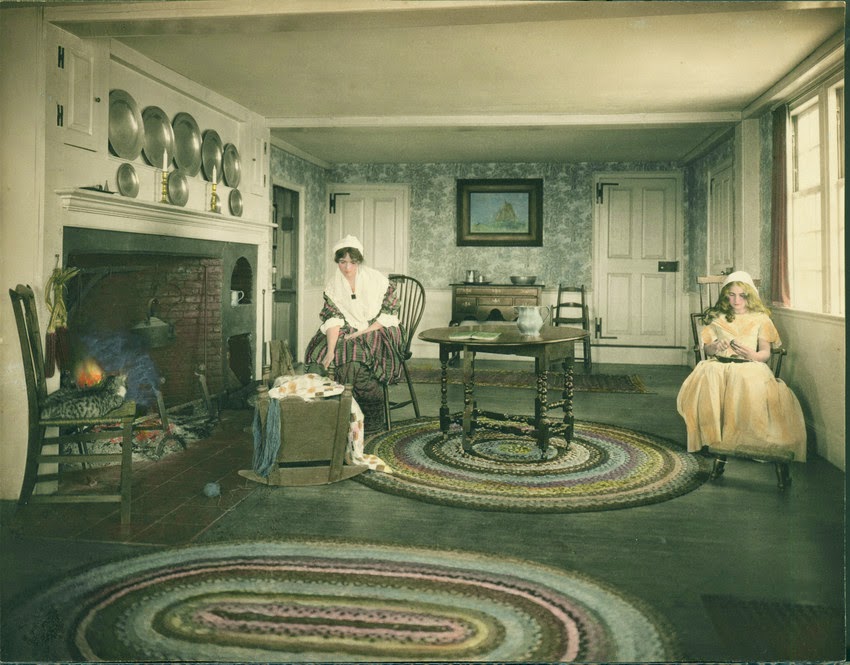
In the Miner Room on the third floor of the Alice, there are two photographs that look like they could have been taken in the Museum. One shows a woman descending an elegant staircase, and the other a woman stirring a pot over an open fire. Both photos are the work of Wallace Nutting, the man who perhaps did more than any other individual to popularize the Colonial Revival. Nutting’s vision of “Old America,” transmitted through historic homes, reproduction furniture, and most of all, photography, shaped the way Americans in the early 20th century envisioned the colonial past.
“The Elaborate Dinner”

Wallace Nutting was born in 1861 in Rockbottom, Massachusetts and enrolled at Harvard in 1883. During the summers he worked in hotels at various popular resorts in New England—Campobello Island, Martha’s Vineyard, Nantucket—that he would later return to as a photographer. After graduating from Harvard, he went on to Hartford Theological Seminary and Union Theological Seminary, becoming a Congregational minister in pulpits around New England.

In the early 1900s, however, Nutting began to suffer from neurasthenia--a disease peculiar to the Victorian era, characterized by fatigue, anxiety, and weakness, and thought to be caused by the stresses and strains of modern urban life. He left the church for good in 1904, and he and his wife, Mariet, purchased a derelict farm in Southbury, Connecticut. Nutting had been a dedicated amateur photographer since his college days, and photography was in fact often recommended as therapy for neurasthenia, because it combined artistic pursuit with healthful outdoor activity. He now turned to photography as a means of supplementing his income.
One of the many versions of “Cherry Blossoms”

The subjects of Nutting’s photos were almost exclusively rural, and rarely showed any indications of modernity. Pastoral fields of cows, country lanes, blossoming trees, and old barns were some of his favorite subjects. These scenes of an unspecified but clearly pre-industrial era were enormously appealing to middle-class urban dwellers.

Between 1905 and 1912, Nutting (with Mariet’s assistance) perfected a system for producing high-quality colored photographs on a large scale. The photos were printed using the platinotype process and then tinted with watercolors, following a model, by a carefully-trained staff of young women. Nutting produced his first catalog in around 1910; it depicted over 500 photos and noted that many more were available. Prices ranged from $1.25 for the smallest pieces (5” x 7”) up to $20.00 for the largest (20” x 40”)—well within the reach of most middle-class consumers.
A typical Nutting colonial vignette

While the outdoor views made up the bulk of the catalog, it was Nutting’s colonial interiors that were the most popular. By 1911 he was offering about 200 different interior scenes, which accounted for about a quarter of his total picture sales. Mariet Nutting had first suggested staging scenes with models—usually the young women who worked as colorists—to create “period vignettes.” 

Though Nutting was producing his photos in the age of the “new woman,” the suffragette, and the flapper, his pictures showed women in decidedly traditional roles. Either they were shown engaged in genteel leisure activities—reading, writing letters, drinking tea—or in productive (but still genteel) work—spinning, sewing, cooking. In a time when gender roles were rapidly changing, Nutting’s pictures offered a reassuring vision of the past.

In order to make sure that the settings in his photographs were authentic, Nutting began to collect furniture, rugs, costumes, and other items that could be used as props. Then, to ensure that he always had suitable backgrounds, he began to purchase the historic properties which eventually would become the Wallace Nutting Chain of Colonial Picture Houses. The five houses, purchased and restored between 1914 and 1916, included the Joseph Webb House in Wethersfield, Connecticut; the Wentworth Gardner House in Portsmouth, New Hampshire; the Hazen Garrison House in Haverhill, Massachusetts; the Cutler-Bartlett House in Newburyport, Massachusetts; and the Ironmaster’s House in Saugus, Massachusetts. 

17th-century cupboard made by Wallace Nutting
As a financial investment, the houses never lived up to Nutting’s hopes, because their opening coincided with the first World War and the imposition of gasoline rationing, which severely curtailed tourism. But they did help solidify his reputation as an expert on historic architecture and furnishings. Nutting also started to manufacture his own line of reproduction furniture in 1917. He considered the colonial-inspired pieces produced by the big companies to be “humbug furniture,” while his own pieces were worthy of being called the “antiques of tomorrow.” Nutting’s furniture was authentic in appearance, though his workers did use modern construction techniques and machinery.

In addition to all his other ventures, Wallace Nutting was a prolific writer and lecturer. In the 1920s he began writing travel guides, the States Beautiful series, that took readers on virtual tours (illustrated with his own photographs, of course) of the states of the eastern seaboard. He also bolstered his reputation as a furniture expert with three books on the history of American furniture: American Windsors (1917), Furniture of the Pilgrim Century (1924), and Furniture Treasury (3 volumes; 1928 and 1933). Alice owned all of these books on furniture.


Photo by Wallace Nutting taken in the parlor of the Webb House.
Note that the murals depict two of Nutting’s other properties,
the Hazen Garrison House and the Saugus Iron Works.
Although Nutting was convinced of the superiority of the past, he nonetheless was a very modern businessman. Nutting employed an advertising agency beginning in the early 1920s, which produced print campaigns for magazines like Antiques. These advertisements were carefully targeted at middle-class customerspeople who did not have their own family heirlooms that “came over on the Mayflower” but liked to think of themselves as people who should have such fine items. All of his ventures were carefully planned to work together: the historic homes provided settings for his photographs; the books educated consumers about the furniture; and the photographs generated interest in the historic properties and the furniture. 

Above all else, Wallace Nutting saw himself as an educator, one with a very specific moral lesson to impart about the values of rural, pre-industrial America. That this idea owed as much to his imagination as it did to reality was unimportant. Nutting’s vision, combined with shrewd business tactics, tapped into a vein of nostalgia about the past and made him the foremost popularizer of the Colonial Revival in the early 20th century.


Sources:

Thomas Andrew Denenberg, Wallace Nutting and the Invention of Old America (New Haven: Yale University Press, 2003).

Richard Guy Wilson, Shaun Eyring, and Kenny Marotta, Re-Creating the American Past: Essays on the Colonial Revival (Charlottesville: University of Virginia Press, 2006).

Joyce P. Barendsen, “Wallace Nutting, an American Tastemaker: The Pictures and Beyond,” Winterthur Portfolio 18, no. 2/3 (July 1, 1983): 187–212.


Tuesday, March 25, 2014

A Carpet Bag's Story

I recently came across this accounting of one of the objects in the museum collection. This carpet bag belonged to William Miner's uncle John, and is now safely tucked away in storage. Its history teaches us of Uncle John and Aunt Huldah's lives as well... John and Huldah raised two orphans - Dora and their nephew William. I hope you enjoy the tale. To read more about Eva and Dora see my blog post from September 12, 2008, or click this link http://minermuseum.blogspot.com/2008/09/family-returns.html

"Written by Eva Simonds Vincent, daughter of Dora LaPorte Simonds, in her late eighties. She donated the carpet bag to the Alice T. Miner Museum.

After Eva's death in February of 1983, her sister Anna had Eva's story typed and gave it, too, to the Alice T. Miner Museum.

As we grow older our memory wanders back to days of long ago. I opened my closet door one day and found my old - but not quite forgotten - carpet bag hanging there. That old bag seemed to be trying to tell me a story, so I listened to what it had to say.

A Carpet Bag's Story

Many things have happened to me in my life - me, an old carpet bag! Did you know that Eva you are the third girl to care for me?

But my story begins with a very young man. Oh, he was tall, handsome, and very anxious for travel and adventure. He came into the store in this very small settlement in Northern New York State and bought me. My colors were bright, and fine leather handles had I then. I was very excited, for he packed me with what clothes he had and we headed for the west coast! a far place from my little settlement home.

It was 1849, and many times I heard men whispering the words "Gold in California!" The trip was not easy, but my new master, John Miner and I were young and eager for adventure.

While we were prospecting, a different kind of fever than the one that brought us out there broke out in camp. John, only 20 years old, came down with yellow fever. The Doctor did all he could for him, but John was very bad. Water was forbidden to the sick, but that was what he craved.

Now young Master John had a belt around his middle. In it he kept the gold nuggets that he had collected. Even while he was so sick, he bribed a small boy who ran errands for the men to bring him a watermelon. He hid that watermelon under his cot with me. He would suck on it piece by piece for the water that he craved.

When the Doctor visited again, Master John's condition was very much changed! The Doctor claimed that John had 'fever-eating watermelon', and that's the reason he lived to bring me back to the east and my home again.

When we returned, John decided to take part of the homestead and marry. He found a pretty young girl named Huldah. She was very young - yes, twenty years younger than John. Huldah was the first girl to love and care for me, and she layed (sic) me safely away with the belt in which my master had carried his California gold. The gold was gone now. Some of it John used to buy gold banded dishes for his bride.

When John and Huldah had been married for three years, Dora, a child whose mother had died, came to live with them. She became the second girl to love and care for me. When she was old enough to play dress-up, she carried me everywhere!

Dora, Uncle John, and Aunt Huldah, ca. 1867
Many happy years passed and before I knew it, it was time for Dora to be married. She was married in John and Huldah's home, but afterwards I lost sight of her for awhile. It was a very lonely time for me.

Before I knew it though, Dora's children came, and I was happy again! Her little girl came to visit Aunt Huldah and Uncle John and to play with me. What happy years those were!

Then came a time when Master John grew sick. He had no 'fever-eating watermelon' this time. It was very sad for me when my young Master John died.

Dora is the woman seated on the left... and could that be Aunt Huldah next to her?
Dora and her family came to live again in Master John's house with Huldah. We were to have a happy time again. My first and second little girls were together again. Dora's child, Eva, was the third little girl to love and cherish me.

Eva and Anna Simonds
As time goes by, those we love pass away. Huldah, my first little girl, went to be with my Master John. 

Dora packed me away for a long time in her closet. When she went to live with her daughter, my third little girl, I was happy once again. Eva took very loving care of me for I was nearly one hundred years old! Many happy years passed.

My Dora is long gone now, but I am still with old friends. Eva has no little girls to pass me on to, but she has arranged it to return me to the very spot where I was bought so many years ago by my young Master John! Where the old store stood, there is now a very fancy stone museum! It will be wonderful to be loved and at rest - and home!"


Friday, June 7, 2013

The Constable's Daughter

This year The Alice celebrates a significant event in our museum's history, a sesquicentennial! Alice Trainer Miner was born in Goderich, Ontario on September 23, 1863. She was the youngest daughter of twelve (surviving) children born to Louisa Saunders Trainer and Bernard Trainer. Bernard was a carpenter, and also served as Chief Constable of Huron County, which included the town of Goderich.

Alice Trainer, ca. 1878
Early in 1870 Louisa Saunders Trainer died while giving birth to twins (who also did not survive), leaving Alice and her siblings to be raised by their father - with help from his oldest daughter, Matilda. Just nineteen when she took over raising the rest of the children, Matilda (also known as Tillie) had begun teaching school at the tender age of fourteen. At the time of their mother's death the children ranged in age from seventeen (Ephraim) to age four (William). Despite her new role as surrogate mother Tillie apparently kept her teaching job. She is listed in the Province of Ontario 1871 census as "teacher, common school".

Matilda Trainer, ca. 1878
Bernard Trainer was Chief Constable and often quoted in the local press. Trainer played a role in a notorious murder case in Canada and is mentioned in the book Double Trap: The Last Public Hanging in Canada written by John Melady (incidentally a relative of the accused in this case). The museum does not possess photographs of either of Alice's parents, although we have a handful of wonderful portraits of Alice, some of her siblings, and their maternal grandparents James and Jane Saunders.

James Saunders and Jane Woolocott Saunders, ca. 1852
In 1880 Bernard Trainer passed away at the age of 54. In 1887 Tillie moved the girls and their youngest brother William to Chicago, Illinois so they could live nearer to older brothers - James, (listed in the same 1871 census as a law student at the age of 16) and Louis. The brothers had immigrated to Chicago in 1881, and the sisters (Matilda, Bertha, Louise and Alice) with young William joined them later. 

James S. Trainer, ca. 1925
Some time around 1893 Alice Trainer met railroad entrepreneur and inventor William H. Miner. And this is where I leave the story of Alice's youth... I hope to write more about our founder in the next few months leading up to her birthday on September 23.

Alice Trainer, ca. 1893

Tuesday, March 19, 2013

A Trip to Williamstown


One of my roles as a museum director is to oversee the process of conservation of the Alice's collection. This requires looking at priorities designated by a conservator who surveyed our objects years ago as well as heeding the recommendations of our collections committee in light of the inherent value of the objects to the museum. "Value" can be a very subjective term, so I'll clarify that by saying we decide what to send for conservation based on what is valuable and necessary for telling the story of this museum, it's founder, and it's wonderful collection.

(All photos courtesy PHOTOPIA/Shaun Heffernan)


the furniture conservation studio at Williamstown

We recently delivered two tables from the collection to Williamstown Art Conservation Center in Williamstown, MA. Although it requires a very long day of driving, I really enjoy this aspect of my job. The drive is lovely and what awaits in Williamstown is always interesting and stimulating. Unless I am in a hurry to get back on the road home I always happily accept a tour of the conservation rooms. I find it really exciting to see the works of art being gently and painstakingly cared for by skilled and patient professionals.

DSCN0049
highly skilled furniture conservator Hugh Glover points out a music bench currently undergoing conservation
detail of the music bench
Included in the many pieces currently in process in the furniture conservation studio is the ornate music bench pictured above. The work that furniture conservator Hugh Glover is doing on the bench is very detailed. The inlay was damaged in several places and  the ivory-monogrammed initials of the original owner had for some reason been crudely gouged out of the piece.  Hugh was able to obtain a cast made from a companion piece but subsequently found it was slightly too large. He will need to work to make a new one the proper size and will then carefully affix it in the original place.

At Williamstown it never fails that I will see pieces by artists familiar to me. This time the paintings conservators had about half a dozen George Inness works in their studio. They are in the midst of conserving the pieces for the Clark museum, which is affiliated with the art conservation studios and is located on the same campus. Inness (1825-1894) was an American landscape painter whose influences included the Hudson River school.

DSCN0079
one of a group of George Inness paintings in the conservation studios
DSCN0055
Hugh Glover explains work in progress on a mirror in the furniture conservation studio
DSCN0057
Hugh and I examine the drawers from one of our objects brought for conservation
The two tables I left with Hugh for conservation will likely be at Williamstown for months as they undergo treatment. The museum will get a detailed report on the work completed as well as before and after photographs taken at the studios. Later this year I will drive back to see what new works are in progress and to usher our collection items back to their home in the North Country. Hopefully I will have time for another tour. Aside from the variety of wonderful artwork, furniture and objects in progress at Williamstown, the studios are the envy of any serious artist or craftsperson. The recently erected facility has very well planned studios with state of the art lighting, ventilation, storage and workspace - so much wonderful space! As an artist I dream of having just a portion of one of these wonderful studios within which to do my printmaking, drawing, painting and dreaming!


a sculpture from the New York State art collection