Showing posts with label William Miner. Show all posts

Wednesday, August 8, 2018

Food Will Win the War: The New York State Food Commission

Last month’s Centennial Summer Fair at Miner Institute gave us the opportunity to learn more about the history of food and farming during World War I. From large enterprises like Heart’s Delight Farm to vacant-lot city gardeners, all Americans were urged to do their patriotic duty by producing and conserving food to the best of their ability. Not only were they responsible for feeding themselves, they also had to provide for the United States army overseas and assist with food relief efforts in Europe. The United States had abundant agricultural resources, but organization was required to use them effectively. This will be the first of three blog posts exploring this topic in more depth. Here we’ll present a broad overview of the federal and state agencies created to “win the war in the kitchen.”

A simple and direct message from the
U.S. Food Administration
Soon after the US declared war on Germany in April 1917, President Woodrow Wilson established the United States Food Administration and appointed Herbert Hoover as its head. Since 1914, Hoover had been directing food relief efforts in occupied Belgium and France, so he was well aware of the importance of food to national security. He also believed that it was possible to tackle the food problem through voluntary effort. Rather than imposing rationing or other government strictures, Americans could be persuaded that it was their patriotic duty to comply with the new food regulations. The Food Administration would provide resources and guidance, but it should work through existing organizations rather than create new bureaucratic structures.

In practice, the Food Administration came to rely heavily upon the states to carry its message to individuals at the local level. In New York, Governor Charles Whitman called for the creation of a Food Supply Commission for Patriotic Service in April 1917, which would immediately address some of the most pressing issues, particularly farmers’ concerns about a shortage of labor and consumers’ worries about rising food costs. Later that summer, legislation was introduced which created a new Food Commission under the direction of a three-man board. William Miner was one of the names put forward as a possible commissioner, though it’s unlikely he would have accepted, given his vehement opposition to all forms of government regulation.

Material produced by the state echoed the
messages sent out at the national level
The newly-constituted New York State Food Commission began its work in October 1917, under the direction of John Mitchell, the former president of the United Mine Workers of America. Within the commission there were three main bureaus: production, transportation and distribution, and conservation, each with its own deputy director. Each division then worked with organizations at the county level to disseminate information and resources. In most places, the county farm bureaus (themselves partnerships between the state agricultural colleges and local farmers) became the vehicle for the food commission’s work. In New York City and a few other large urban centers, other organizations were found that could serve this role.

New York State presented some unique challenges when it came to setting and enacting food policies. It was primarily a rural state, with about half the population engaged in agriculture, but it was also home to the nation’s largest city, with an economically and ethnically diverse population. Policies that were good for food producers weren’t necessarily good for those who were primarily food consumers, and vice versa. There were also the needs of a vast array of other food related industries to account for—processors, shippers, wholesalers, retailers. It’s no wonder, then, that the passage of the state food control bill was a contentious process that took months to hammer out.

Workers in the federal and state food bureaus recognized that food was not merely fuel. It was deeply personal and tied up with ideas about home, family, gender, and nationality. Getting people to change the way they ate—to accept “Meatless Mondays” and “Wheatless Wednesdays”—and the way they thought about food, was no easy task. In our next posts, we’ll look at the ways Hoover and his colleagues approached the food problem from two perspectives: that of the farmer and of the housewife. If food was to win the war, both parties had embrace the cause.

Sources:

Report of the New York State Food Supply Commission

Report of the New York State Food Commission for period October 18, 1917, to July 1, 1918

Annual Report of the New York State College of Agriculture at Cornell University, 1918


Wednesday, August 2, 2017

Railroads and Refrigerator Cars: An Episode in the Career of William H. Miner


Charles E. Russell (1860-1941)
One of my favorite things about my job here at the Alice is that I never quite know where my research will take me. The collection is so wide-ranging, and William and Alice’s interests so broad, that anything could happen. Thus it was that I recently found myself reading a book called The Greatest Trust in the World by Charles Edward Russell. Though not as well known today as figures like Upton Sinclair and Ida Tarbell, Russell was also a muckraking journalist, and the book grew out of a series of articles he had written for Everybody’s Magazine in 1905. Though most Americans didn’t realize it, there was an entity that wielded enormous power over their daily lives—and it would ultimately cause the downfall of the California Fruit Transportation Company, William H. Miner’s employer for most of the 1890s.

This entity was the Beef Trust—an organization so powerful, according to Russell, that it had “impoverished or ruined farmers and stockmen, destroyed millions of investments, caused banks to break and men to commit suicide, precipitated strikes, and annihilated industries.” In some places, the trust had so much power that citizens, “even in the privacy of their offices or homes,” dared not speak a word against it. Most Americans thought of companies like Standard Oil as “the ultimate of monopolistic achievement,” but the Beef Trust was “far more vast and powerful.”


A refrigerator car from the 1870s. Ice was used in all cars until
mechanical refrigeration was introduced in the 1950s.
The origins of the Beef Trust (always capitalized by Russell) could be traced back to the invention of the refrigerator railcar in 1874, which transformed how and what people ate—and the biggest effect was on the meatpacking industry, centered in Chicago. Each packing house had its own refrigerator cars, and many railroads maintained their own cars, which could be used by packers at no charge. As Russell explained it, “The railroads were under obligation as common carriers to deliver in good condition the goods that they handled. The refrigerator car was merely an appliance to insure delivery in good condition.”


The Armour packing plant in Chicago, ca. 1910
Inevitably, the meatpacking companies consolidated into four main firms: Armour, Swift, Hammond, and Morris. The “big four” were then able to persuade the railroads (Russell doesn’t explain exactly how) to compensate them for using their own refrigerator cars for shipping. In the end, the railroads agreed to pay 3/4 of a cent for every mile hauled. That didn’t sound like much, but it added up to about $7.50 per car for every trip between Chicago and New York. This made it very difficult for companies that didn't own their own refrigerator cars to compete, and allowed the Beef Trust to control the prices of cattle and dressed beef.

By around 1900, the Beef Trust owned about 80% of all the refrigerator cars in the United States, and were transporting all manner of perishable goods, not just meat. Rival firms that did have their own cars “found that the cars of the bigger and more aggressive packers were favored by the railroads, handled more rapidly, sent back with less delay; that the car of the big house was in fact a club to beat the smaller firm to death; and they gradually got out on the best terms they could obtain. Thus the refrigerator car formed the Beef Trust.”


Shipping fruit was serious business, and
all communication had to be in code.
So where do William Miner and the California Fruit Transportation Company come in? CFT was a subsidiary of the Hutchins Refrigerator Car Company, a pioneer in the industry. Around 1886, Carlton B. Hutchins of Detroit developed an improved refrigerator car that used wool scraps from the garment industry for insulation. Hutchins went into partnership with F. A. Thomas, a Chicago fruit and produce dealer, and in 1888 they transported their first cars of fruit from California to Chicago. This was a risky business—Thomas had to purchase the fruit outright from the growers, who were skeptical of the refrigerator cars’ ability to keep the fruit from rotting. But it worked, and the California Fruit Transportation Company was born.

At first, the owners had every reason to think that “they had something better than a gold-mine. They voted themselves good salaries as officers...they voted themselves fat dividends as stockholders therein, and nothing seemed as easy as making money.” It was during this flush period, in 1890, that William H. Miner was hired as a mechanical superintendent for the company. His work at CFT would have shown the importance of improved draft gears to cushion wooden railcars shipping delicate cargo, and soon after being hired, he filed a patent for what would become known as the Miner tandem spring draft rigging.


Earl Fruit Company employees, ca. 1910
But thanks to the Beef Trust, these good times were not destined to last. In stepped one Edwin Tobias Earl, owner of the Earl Fruit Company, who supplied close to 80% of the fruit shipped by CFT. Earl requested a commission of $10 per car of fruit shipped—which California Fruit refused to agree to. So Earl went to Armour and rented cars from them instead, and “when the California fruit season reopened the CFT suddenly found that wherever it went the Earl Fruit Company was there also, making war and using a familiar and effective weapon; that is to say, it was offering rebates and getting the fruit.” CFT made an arrangement with the Southern Pacific Railway to haul their cars exclusively, but somehow this “exclusive” arrangement did not preclude Earl Fruit Company from shipping in Armour cars.

California Fruit attempted to find a new market by shipping fruit overseas to Liverpool, but this venture failed, and the company lost more money. To satisfy bank loans, they were forced to transfer 500 of their railcars over to Swift. “A period of febrile existence followed for the California Fruit Transportation Company. It became involved in a business tragedy, features of which were a bank failure, a resulting suicide; and made an end in the transfer to Swift of all the remaining California Fruit Transportation Company’s cars.”

Russell does not give the dates of these events, so it is not clear if they happened while William Miner was still working for CFT, which he did until 1897. But certainly the company’s troubles would have provided him with additional motivation to make a success of selling his draft gear, and eventually go into business for himself. We can speculate, too, as to whether this experience of the power of large conglomerates influenced Miner’s lifelong determination to keep his business in his own hands and personally control all its aspects. Russell wrote in 1905, “To all intents and purposes Swift is Armour, and the California Fruit Transportation is Swift, and the Fruit-Growers’ Express is the California Fruit Transportation, and the Beef Trust is one and all of these together.” But such a thing could never be said of W. H. Miner, Inc.

Sources:

Charles Edward Russell, The Greatest Trust in the World (New York: The Ridgway-Thayer Company, 1905)

L. D. H. Weld, “Private Freight Cars and American Railways,” Studies in History, Economics and Public Law 31, no. 1 (1908).

Wednesday, October 19, 2016

The Origins of Chazy Central Rural School, Part 3

Our series on the origins of Chazy Central Rural School concludes this week. This Saturday, October 22, CCRS will officially mark its 100th anniversary with a variety of events—visit chazy.org for more information.

In Part 1, we looked at the broad social changes happening at the turn of the century and their effect on education. In Part 2we saw how proponents of the Country Life Movement tried to bring city innovations to country schools, and looked at some of the urban schools that inspired William Miner and George Mott. In Part 3, we’ll see how Chazy Central Rural School implemented the ideas of educational reformers.


Chazy Union School, ca. 1900. The building was later
incorporated into Gray Gables.
In 1915, 189 pupils were enrolled in the Chazy Union School in the village of Chazy, which employed 5 teachers. There were also seven schools in Chazy and three in Champlain that would become part of the consolidated school district. These were one-teacher schools that served between 20 and 40 students. The old one-room country school evoked nostalgic associations, but reformers insisted that it was a thing of the past which had no place in a modern, complex society. Thus, any school reform had to begin with the building itself.

Writers on rural schools painted horrifying pictures of run-down, unsanitary, and poorly ventilated school buildings. George Mott, in his proposal for consolidation, drew a stark contrast between Chazy’s “fine homes, well kept lawns, sanitary barns, flowers, and automobiles” and the “one roomed ‘building’ where ventilation is impossible, sanitary conditions a disgrace, and the whole exterior and interior not only so different from their own homes, but oft-times an offense to the eye and a disgrace to the whole environment of the community.” Children could not be expected to learn in stuffy rooms, sitting in uncomfortable seats (Moulthrop Movable School Chairs to the rescue!), under inadequate lighting.

Shakespeare Room, Chazy Central Rural School.
Decorative features in the school were meant to
inspire a love of beauty in students.
New York State Archives
Aside from these practical considerations, reformers also argued that schools should be beautiful. The building itself should be well-designed and made of good quality materials, and interiors should be painted in cheerful colors and decorated with pictures. George Mott wrote that the new Chazy school would be situated on an “ideal rural school site combining beauty with utility.” The 15 acres of land, purchased from Harvey Fisk by William Miner, provided ample space for a large building, “land for agricultural experiments,” a playground, and recreation areas. It also “offer[ed] a natural knoll, upon which the stately building may be seen above even the surrounding tree tops, a ‘thing of beauty and a joy forever.’”

The new school building was to be the setting for a new curriculum. As reformers were quick to point out, rural schools generally used the same curriculum as city schools, in spite of the fact that much of what was taught was irrelevant or foreign to the experience of country children. Mott pointed out that this system of education tended to have two effects on students. Either it pushed them toward the cities, or they became “disgusted with the hollowness and the unsatisfactoriness of such an education, and fall by the wayside with a contempt for that which they call ‘book learning.’” The solution was to make sure that the curriculum of rural schools was grounded in the everyday life of the country.

Agriculture Laboratory and Lecture Room,
Chazy Central Rural School
The goal of incorporating agriculture into the curriculum was twofold. One, it was hoped that by learning about nature at a young age, children would develop a love and appreciation for rural life that would help keep them in the country. Two, practical instruction in agriculture would be an important step towards introducing modern, scientific farming. Many in the country life movement felt that it was too late to reach adults and that it was better to focus their efforts on children. As William Miner wrote, “It appears to me that in order to improve farming methods in the State of New York, it will be necessary to start with the sons and daughters of farmers, during their school years to thoroughly drill them in habits of orderly, thorough and businesslike methods in dealing with the problems of enlightened agriculture….As you know, the minds of young people accept impressions and improved ideas far more readily than could be hoped for in dealing with the thinking apparatus of middle aged farmers, who proudly announce that the methods of their grandfathers are plenty good enough.”

Scientific Cookery, Chazy Central Rural School

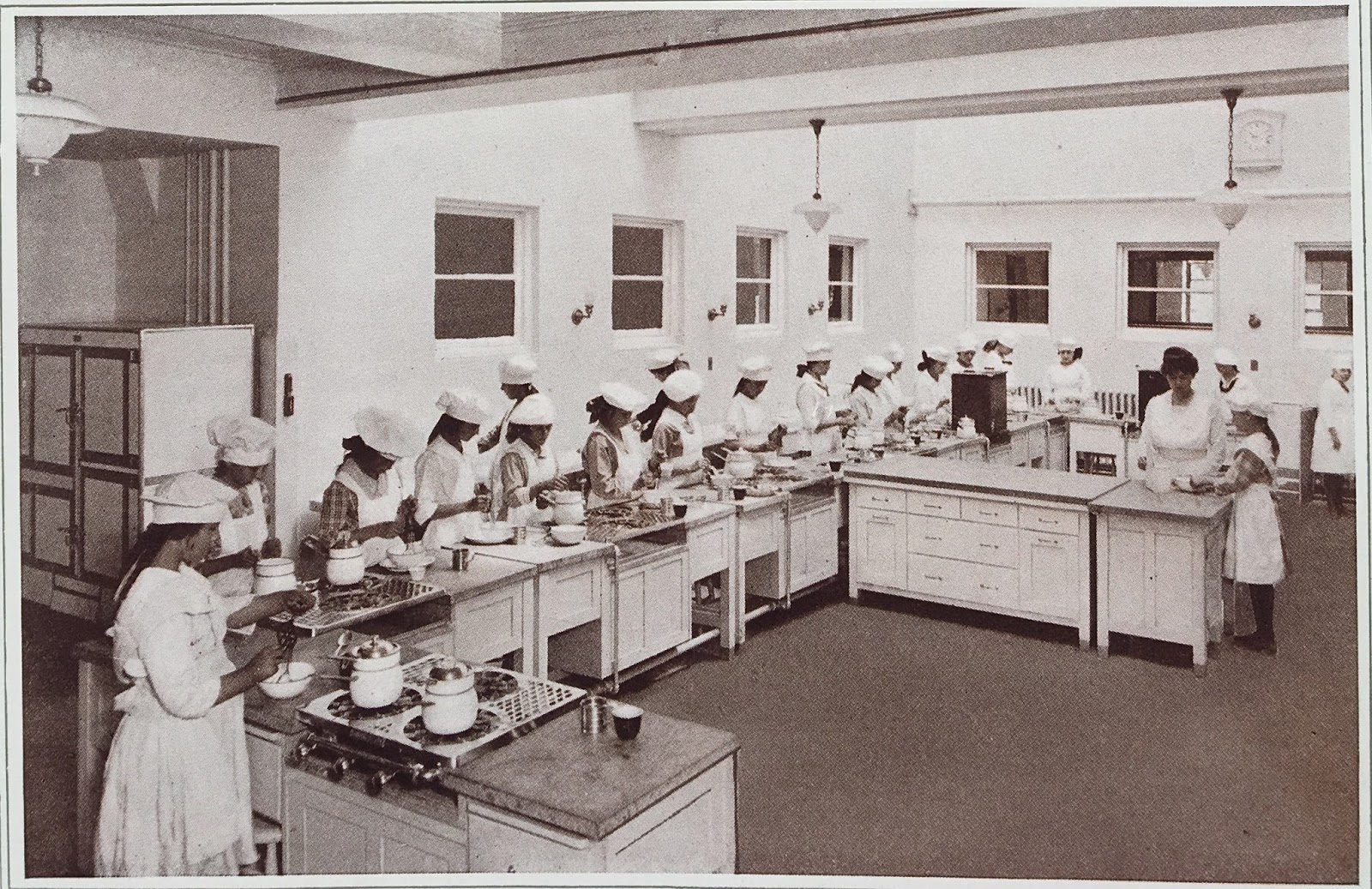
Courses in agriculture were aimed at turning boys into modern farmers, while the Household Arts program approached housekeeping from a scientific perspective. The farm home also needed updating. “Far be it from any of us to criticize the bountiful and satisfying country meal of childhood,” wrote George Mott, “but the question still remains unanswered as to who is educating the growing girl to take the place of her mother in these days of canned groceries, tinned meats and tissue wrapped bread.” It was the school’s responsibility to “teach the girls not only sewing and cooking, but the application of modern scientific principles in food values, well balanced meals, the detection of impure foods, the proper organization and administration of a well organized home on an economic basis.”

Although agriculture, domestic science, and other vocational skills were an important part of rural education, the traditional academic subjects were also taught, along with drawing, music, handicrafts, and physical education. Carrying out this new curriculum required highly trained teachers who understood the special needs of rural schools. Reformers identified what they called the “teaching problem” as one of the main obstacles to improving rural schools. Many teachers had only high-school educations themselves and were barely older than their students. Short school terms and irregular attendance made it difficult for teachers to make progress. Teachers in rural schools had a harder job but were paid much less than their urban counterparts. In Chazy, they earned, on average, about $10 per week. School was in session for 36 weeks per year, and only about 65% of the students officially enrolled actually attended school regularly.

Providing faculty housing was one potential
solution to the problem of retaining good teachers.
One of the aims of the rural school reform movement was to make country schools more attractive to teachers and to find potential teachers who would not be deterred by the special challenges of rural life. The advertisement for prospective teachers laid out the situation quite clearly: “As the village of Chazy has only about 300 inhabitants, teachers who are dependent upon the city for means of study, recreation and amusement, will find few inducements. On the contrary, those who enjoy rural life and who wish to have part in a great undertaking where there is opportunity for pioneer work in a worthy field, will find that this school offers them many advantages.”

When it came time to work out how all these changes in teaching, curriculum, and infrastructure were to be brought about, the answer inevitably was centralization and consolidation. Consolidation of small school districts would increase the financial resources available, facilitating the hiring of better-trained teachers, including specialists in the new subjects proposed for the rural curriculum. Modern facilities could be created, and grading and/or platooning instituted. Children would benefit from schools with larger enrollments that would “provide social and cultural contact with companionable associates necessary to the best development of every child.” However, consolidation was a common sticking point when it came to actually carrying out rural school reform. 


Reformers attributed resistance to conservatism, ignorance, or just plain stubbornness, but rural communities articulated valid concerns about proposed reforms. They worried about the costs associated with changes, and did not want to relinquish control over their small, local school districts. They often felt that reformers were condescending and resented the implication that the rural family was failing in its educational role. They were also concerned that the reforms being instituted were meant to benefit urban areas—that the ultimate goal was to make the countryside more productive in order to support the cities. And there was often some truth to that.

Article from the New York Times,
October 16, 1921
What may be most remarkable about Chazy Central Rural School is not the form of the school itself, but the fact that William Miner and George Mott were able to carry out their ambitious plan. A year after the proposal was first brought before the public, the school was open (though not yet complete) and within a few years was attracting attention from all over the United States. Here was a community that had actually accomplished what most people only talked about.

William Miner’s financial support of the school project eliminated one of the major obstacles and potential objections to the plan. As someone with family roots in Chazy, who had himself attended a one-room district school, residents probably felt that he could be trusted to have their best interests at heart, in spite of his wealth and connections to the broader reform movement. And George Mott, whatever his flaws in other areas, was skilled at generating enthusiasm among the members of the community and making them feel that they had been offered a rare opportunity that they would be foolish to reject.

In the 100 years since Chazy Central Rural School welcomed its first students, much has changed in American society. Although agriculture still plays an important role in the economy of Chazy, we no longer assume that most boys will grow up to be farmers, and most girls to be housekeepers, and the curriculum has changed to reflect that. In 1968, a new school building was erected and the original building torn down. But Chazy Central Rural School continues to be, in many ways, the center of public life for the community. Indeed, that may be even more true now than it was in the early 20th century. In those days, the school was closely identified with William Miner, but now we can say it is an institution that truly belongs to the community of Chazy.


Wednesday, October 5, 2016

The Origins of Chazy Central Rural School, Part 1

As we approach the 100th anniversary of the opening of Chazy Central Rural School, I thought it might be interesting to take a closer look at its origins. These blog posts, which will delve into the historical context of the school’s founding, are based on a talk I gave for the Clinton County Historical Association. Part 1 looks at the broad social changes happening at the turn of the century and their effect on education.


Chazy Central Rural School
From a set of instructional lantern slides produced by
the New York State Education Department, 1919
New York State Archives
When Chazy Central Rural School first opened its doors to pupils in the fall of 1916, it was like nothing that had ever been seen before in the North Country. A five-story Spanish Mission style structure, topped with turrets and a bell tower, it towered over all the other buildings in the village. Inside were classrooms for students from first through twelfth grade, laboratories and workshops, two swimming pools, a thousand-seat auditorium with film projector and organ, doctor’s and dentist’s offices, and a sunlit cafeteria where students ate at marble-topped tables.

Rev. George R. Mott,
first Dean of CCRS
CCRS was formed when the village school and ten other rural school districts in Chazy and Champlain merged under a new state law that allowed for consolidation. The two main figures behind the push for consolidation and the creation of a new school were William H. Miner, inventor, philanthropist, and owner of Heart’s Delight Farm; and George R. Mott, minister of the Chazy Presbyterian Church. While their goal was always to create a school that would serve the particular needs of the children of Chazy, they were also deeply connected to broader currents of thought regarding education. CCRS was very much the product of a particular moment in time and beliefs about the role of public schools in 20th-century America.

Chazy Central Rural School grew out of two early-20th century movements: the Progressive educational reform movement and the Country Life Movement, both of which attempted to solve some of the problems associated with the shift from a primarily rural, agricultural society to an urban-industrial one. In both movements, public schools took center stage as as one of the key sites of social change. Progressive educators and advocates of the Country Life Movement had many ideas about what rural schools should look like and what role they should play in rural communities. In fact, if you read the dozens of books on the subject published between 1900 and 1920, and then planned a school based on what you had read, you would probably end up with something that looked very much like Chazy Central Rural School.

So what were the problems that rural school reformers were trying to solve, and why did CCRS look the way it did when it opened in 1916? Over the course of the 19th century, agriculture and rural life had been transformed by demographic shifts and technological changes. In 1835, more than 2/3 of all Americans lived on farms. If you were a white man, you had a good chance of owning property and working for yourself, rather than for wages. But as the United States became a more industrialized nation, that changed. In 1880, the Census Bureau found for the first time that the majority of the workforce was in non-farming jobs. By 1900, two out of every five Americans lived in cities.

Farm family posing with a threshing machine, late 19th c.
from Passion for the Past
For those Americans who remained in the country, farming was altered by the introduction of new machinery and long-distance transportation. Farming had always represented independence and financial security, but by the 1890s, that was less true than it ever had been. Farmers depended upon seed and equipment suppliers, storage facilities, banks, and railroads, which were increasingly part of impersonal corporate conglomerates. They had little control over what prices their products would command, or where they would be sold.

In both city and country, there was a growing sense that schools were not adequately preparing students for life in a modern, industrial society. In cities, this sense of crisis was compounded by a growing and diversifying student population that included first- and second-generation immigrants along with students who did not plan to attend college. In 1890, less than 5% of American adolescents attended high school, but by 1920 over 30% did. Instead of preparing students for college and professions, the high school now also had to provide a general education to students with varying needs. Traditional academic subjects were supplemented by programs in music, drawing, sports, nature study, and the like. Schools expanded their offerings to include technical, business, and other vocational training.

John Dewey, the best-known proponent
of “education for democracy”
In making these changes to American schools, Progressive educational reformers were guided by two main philosophies, which historians have described as “education for democracy” and “education for efficiency.” Proponents of education for democracy emphasized the need to make schools creative environments. They promoted child-centered activities and programs based on the child’s individual interests. The school itself should be a microcosm of the larger society, where students would learn about all aspects of life and would be given opportunities to use their hands as well as their heads. Nurturing the individual child, it was hoped, would help produce a more just, equitable, and democratic society.

On the other hand, proponents of efficiency in education drew upon the practices of business and industry to make schools run more smoothly. They introduced reforms in administration, supervision, teacher training, and testing, with the goal of turning out students who were prepared to take their places in the modern bureaucratic system. In this case, the personal happiness of the individual child was secondary to the needs of society as a whole. These two perspectives could, and did, exist within the same school system. And although their approaches were different, both ultimately had the goal of producing a harmonious society made up of well-adjusted individuals.

In Part 2, we’ll see how proponents of the Country Life Movement tried to bring city innovations to country schools, and look at some of the urban schools that inspired William Miner and George Mott.

Sources:

Joseph C. Burke, William H. Miner: The Man and the Myth (Langdon Street Press, 2009)

Ronald D. Cohen and Raymond A. Mohl, The Paradox of Progressive Education: The Gary Plan and Urban Schooling (Kennikat Press, 1979)

David B. Danbom, “Rural Education Reform and the Country Life Movement, 1900-1920,” Agricultural History 53, no. 2 (April 1979), 462-474.


Friday, June 17, 2016

Visible Astronomy: Colonel Clapp Takes on Newton

William H. Miner’s maternal grandfather, Ephraim Wheeler Clapp, was born in 1796 in Salem, New York. He was one of the six children of Stephen Clapp, a Revolutionary War veteran who operated a mill, and Catherine Wheeler. Ephraim served in the War of 1812, and was thereafter known as “Colonel Clapp.” He married Sarah Rice in 1814 and they established a farm at East Salem and had nine children. Martha, their second daughter, was William Miner’s mother.
Title page of Ephraim Clapp’s manuscript

Sarah Small, a cousin of William’s, recalled that Grandfather Clapp was “a great student. Could tell you all about the different planets, Mars, Jupiter and Saturn, and which one would be the ruling planet for the year, and tell of the big and little dippers and where they were placed, and each year would write it all down. He had complied quite a book on different subjects. He was always pleased when some of the friends came in to visit them, and would be interested in his writings on these subjects.”

A portion of this manuscript, written between 1846 and 1850 and titled “Visible Astronomy,” is in the collection of the Alice T. Miner Museum. Colonel Clapp began his text with a bold claim: “In the following work I propose to introduce a new System of Astronomy, and if in so doing the Newtonian system, should be assailed as incorrect, or if it should merely be annihilated, my only apology is that I have not at any time of my life fully believed in that system.” 

Portrait of Newton by
Godfrey Kneller, 1702
Sir Isaac Newton published his Philosophiae Naturalis Principia Mathematica in 1687. In this book, he laid out the laws of motion and of universal gravitation, and showed that these laws—which could be expressed mathematically—explained both celestial and earthly phenomena: the motion of the planets, tides, equinoxes, and so on. Newton’s work was seen by many as definitive proof of the validity of the heliocentric theory, and by the mid-18th century the Newtonian model of the universe was broadly accepted across Europe and North America.

However, this did not mean that Newton was universally accepted, or that people agreed with all aspects of his work. Challengers to Newton ranged from those who saw unexplained problems in his theories (such as the precise nature and source of gravity) that they attempted to resolve, all the way through proponents of fringe theories like Flat- and Hollow-Earthers. Others objected to Newton on scriptural grounds, arguing that his picture of the universe was contrary to the Bible’s description of sun, moon, and stars fixed in a firmament that revolved around the earth. Some people felt that Newton’s mechanistic universe, running on mathematical principles, opened the door to rationalism and free thought.
Clapp’s diagram showing Newton’s supposed error
regarding the size of the sun.

Still, by Ephraim Clapp’s day, anti-Newtonianism was a pretty eccentric position. His objections to Newton seem to have come from his belief that Newton was mistaken about some fundamental facts. Clapp argued that the sun cannot be as large as Newton says it is, because if it were, the earth would never experience days and nights of equal length. Moreover, Clapp claimed, if Newton were correct about the size of the sun and the distance of the earth’s orbit around it, the earth would have to be moving so fast that gravity would cease to function and “every thing moveable would fall from the earth.” (This is just in the first two pages of the manuscript, by the way.)


Page from Principia Mathematica
I am not a scientist, but it seems to me that Clapp’s theories are doubtful, to say the least. But his manuscript does raise some interesting points about how ordinary people understood science and tried to incorporate it into their own lives. It would be very interesting to know where Clapp got his knowledge about the Newtonian system. Principia Mathematica is a dense text, full of mathematical equations and diagrams—and it was in Latin. So relatively few people actually read it in its original form, instead relying on translations and books that simplified Newton’s work for a general audience, such as The System of the World, Demonstrated in an Easy and Popular Manner: Being a Proper Introduction to the Most Sublime Philosophy, published in 1740. Americans in the late 18th and early 19th centuries also had access to a wide variety of encyclopedic works on natural history aimed at the general public. Astronomy had an important place in these texts. In addition, lecturers traveled around the country, giving talks and performing scientific demonstrations. Ephraim Clapp might very well have read these types of books and attended scientific lectures. But his ideas about the nature of the universe seem to have been entirely his own.


Friday, April 8, 2016

San Francisco In Ruins: Photographs of the 1906 Earthquake and Fire

“The historians of modern or ancient times have never recorded such a maelstrom of terrified, horror and panic-stricken human beings as awoke to the realization of the master seismic tremblor, in the City of San Francisco at 5:13 on the morning of April 18th, 1906. The initial quake, being followed by many of less severity, tumbled chimneys, large and small buildings of poor or faulty construction, broke water mains and ruptured electric light and power conductors, causing many conflagrations in a few moments. Then followed a catastrophe unparalleled in modern times, a disaster beside which, for property losses, the Chicago fire the Johnstown flood, the Galveston tidal wave, the Mont Pelee eruption, Vesuvius’ spouting and the Baltimore fire, fade into infinitesimal disturbances on the records of Father Time.”

This is how author A.M. Allison described the devastating earthquake and fire that struck San Francisco and the surrounding area in the introduction to San Francisco In Ruins: A Pictorial History of Eight Score Photo-Views of the Earthquake Effects, Flames’ Havoc, Ruins Everywhere, Relief Camps. I recently came across this book while reorganizing the Alice’s book collection, and since we are less than two weeks away from the 110th anniversary of the earthquake, it seemed like a good time to take a closer look at it, along with some related items in the museum archives.


“Citizens Rendezvousing on the Vacant Places
When the Fire Was Raging in the 

Mission District,” J. D. Givens
The photographs in San Francisco in Ruins are the work of James D. Givens (1863-1939). Givens moved to San Francisco in 1899 and established his home and studio at the Presidio, a U.S. Army base on the peninsula. He became the post photographer and recorded the personnel and daily activities of the post. He also went to the Philippines in 1900 to document the Philippine-American War and to Mexico with General John J. Pershing during his pursuit of Pancho Villa in 1915. Givens was just one of many photographers, professional and amateur, who produced images during and after the disaster. The San Francisco earthquake is probably the first natural disaster to be thoroughly photographed, as it occurred at a time when inexpensive, portable cameras had become available to a large portion of the population, who used photography to document their experiences, create insurance records, and produce souvenirs for sale.

As we saw in a previous post, William Miner took up photography as a hobby in the late 1880s, and brought his camera along on his frequent business travels. William frequently traveled to California, first as an employee of the Hutchins Refrigerator Car Company and its subsidiary the California Fruit Transportation Company, and later representing his own company. He visited San Francisco in 1906, at a time when the destruction caused by the earthquake and fire was still very much in evidence, and recorded what he saw in a set of photos now in the Alice’s archives. Here are some of his photographs.


In the distance is the Fairmont Hotel, which was still under construction
at the time of the earthquake
Grace Church, California Street
In the background are the Call newspaper building and the Mutual Bank building.
Another view of the same street.


It is estimated that between 3,000 and 5,000 people died in the earthquake and subsequent fire, and about three-quarters of the city was damaged. Two years later, people were still living in refugee camps. However, political and business leaders downplayed the effects of the earthquake, fearing loss of outside investment which was desperately needed to rebuild. Reconstruction plans were quickly developed, and less than ten years later, the city hosted the Panama-Pacific International Exposition of 1915. (This world’s fair is also important because it started a fashion for Spanish colonial architecture, which likely influenced the design of Chazy Central Rural School.) But the thousands of photographs in archives, libraries, and personal collections today remain as documents of the events of April 1906.

You can look at a copy of San Francisco in Ruins at the Internet Archive—or come see Alice’s copy when we reopen next month.

Friday, December 4, 2015

William H. Miner, Amateur Photographer

Horses at Heart’s Delight Farm pose for the camera
One of the highlights of the Heart’s Delight Farm Heritage Exhibit is the display of photographs of life and work on the farm ca. 1910. These beautiful photos, which bring Heart’s Delight Farm to life, are just some of the hundreds of photographs that exist of William Miner’s various enterprises. Professional photographers produced albums and booklets that documented the farm, Chazy Central Rural School, Physicians Hospital, the Alice, and the Kent Delord House; these were supplemented by informal snapshots taken by William and his friends. Not surprisingly, given his interest in new technology, William took up photography more or less as soon as it became accessible to the amateur. And, as I’ve recently learned, he had his work shown at one of the first major exhibits of amateur photography, the Eastman Photographic Exhibition held in January 1898 at the National Academy of Design in New York.


Kodak advertisement, 1889
Eastman Kodak was the largest producer of cameras and photographic accessories in the United States, and indeed the company that had made photography a popular pastime. In 1888 George Eastman introduced the first Kodak camera, which came preloaded with a roll of film that produced 100 circular photos, 2.5 inches in diameter. Photography no longer required bulky cameras, glass plates, or darkroom apparatus. As the company’s famous slogan proclaimed, “You press the button—we do the rest.” Over the years, Eastman produced ever smaller, simpler, and less expensive cameras—the pocket Kodak in 1895; the Brownie in 1900. Naturally, the company was interested in promoting photography as a popular hobby, but the National Academy show aimed to prove that it was an art form as well.


A very bad digital version of a scan of a
microfilmed edition of Godey’s Magazine. 
William Miner’s photograph captured the Administration Building at the 1893 Chicago World‘s Fair at night, its electric lights ablaze and reflected in the lagoon below. He won a prize of $25.00 in the category of contact prints taken with a timed exposure. In an article in Godey’s Magazine on the show, author Marmaduke Humphrey said of William’s photo that “the light reflections on the water arouse suspicions that the plate has been doctored—or should we say artistically bettered—to prove the photographer’s control over his work.” As Humphrey quite bluntly stated, if you claimed that photography was not an art, “you do not know what you are talking about.” The photographer controlled composition and lighting; he “can select, omit, heighten, or diminish values, choose his own tones, give an individuality to his work, and accomplish almost any of the general effects of the arts that work in only one color.” In short, it is “a fine art.”

The extensive technical displays at the 1898 exhibition, which demonstrated the effects of various papers and developers on photographic prints, suggest that although Kodak made it easy for anyone to take snapshots, there were still plenty of people who were interested in exploring the finer points of photography. Like William Miner, they experimented with various ways of manipulating negatives and prints to get the artistic effects they sought. 


Electricity Building, showing competing
exhibits by Westinghouse and General Electric
The Columbian Exposition was the first world’s fair to make extensive use of electricity in its exhibits, and it was the place that many Americans got their first exposure to electricity in action. In addition to the thousands of electric light bulbs that illuminated the structures and grounds, there was an entire Electricity Building that exhibited motors, generators, transformers, and other equipment, along with examples of appliances that ran on electricity. 

The Chicago World’s Fair was also the first to use photography for promotional purposes. In addition to the images produced by official photographers Charles Arnold and William Henry Jackson, other entrepreneurs were licensed to publish their own photos of the fair. Add to that the many individual visitors who brought their own Kodaks, and the fair must have been one of the most thoroughly documented events in the world up to that point.

William Miner’s contribution to the Eastman exhibit, which brought together the World’s Fair, electricity, and photography, seems to perfectly embody the spirit of the 1890s. The way that it combines up-to-date technology with aesthetics is also typical of William Miner, who consistently strove to unite the useful and the beautiful.

For more on the Eastman Photographic Exhibition, see this article from The Photo-Beacon (March 1898), which includes some reproductions of photos in the show (though not William’s, unfortunately).

P.S. Did you know that if you are a resident of New York State you are eligible to obtain a New York Public Library card, and that with the card you can access many online databases? This how I found the article in Godey’s Magazine, which is in the American Periodicals (1740-1940) database.