Showing posts with label WWI. Show all posts

Friday, August 31, 2018

Food Will Win the War: Recruiting an Army of Food Savers

The state and federal agencies formed to tackle the food problem during World War I approached the issue from the perspectives of both the producer and the consumer. As we saw in our last post, the New York State Food Commission developed a variety of resources to assist farmers in increasing their crop and livestock yields, including supplying improved seed, providing assistance in pest and disease management, and helping to address the farm labor shortage. These programs were largely successful, but they were only part of the solution. Americans would also have to fundamentally change the way they cooked and ate their daily meals.


U.S. Food Administration poster
urging Americans to save wheat for soldiers
Since women were responsible for purchasing and preparing almost all food consumed in the home, all food conservation programs targeted housewives. The U.S. Food Administration and the state food commissions aimed to persuade women that it was their patriotic duty to adopt wartime food-saving measures, such as wheatless and porkless days. As authorities continually emphasized, there was no shortage of food in the United States; it was a matter of substituting those foods that were not needed or suitable to send overseas with those that were. But Americans were accustomed to a diet that relied heavily upon meat and bread. Meat was easy to cook and it almost always tasted good; bread was cheap and accessible. Could people be persuaded that fish, eggs, and cheese were acceptable substitutes for pork and beef, and that bread made with corn, rye, oats, and barley just as good as that made from wheat?

A small army of women stepped forward to help the government with this difficult task. Since the late 19th century, (white, middle-class) women had been working to establish domestic science as a profession; they had been successful in starting domestic science and home economics departments at colleges and universities (including the New York State College of Agriculture in Ithaca) and sending their graduates forth into the world to work in high schools, settlement houses, and extension services. For many of them, World War I must have seemed like a godsend: finally they would have the opportunity to demonstrate to the wider world just how important their discipline was. The work that women did in the home affected their families, communities, and indeed, the nation—and it was essential that they do it right.


Cornell Home Economics Faculty, 1914.
Bertha Titsworth is standing at far right.
Home economists and experts in “scientific cookery” went to work preparing menus and recipes for wartime foods. Experimental kitchens were set up across the country to test bread recipes, hoping to find the perfect formula that would use less wheat but still be palatable and easy for the home baker to make. They figured out how to make desserts without sugar, introduced housewives to unfamiliar new ingredients like soybeans, and came up with creative ways to use leftovers. They also introduced Americans to the science of nutrition, explaining what kind of foods were necessary to good health and why. They provided assurance that the changes in diet encouraged by the Food Administration would do no harm, and in fact, eating more vegetables and less sugar would probably do everyone a lot of good. 

All of this information was distributed in cookbooks, pamphlets, magazines, and newspapers, and at schools, women’s clubs, and county fairs. The Plattsburgh newspapers regularly published lists of new material on food conservation received by local public libraries, and ran columns of “Victory Menus.” Women in Clinton County also had many opportunities to learn directly from food experts. In July 1917, the Plattsburgh Sentinel reported that “women representing different sections of the county as well as the Grange and various women’s clubs” met at the Farm Bureau office in Plattsburgh “for the purpose of organizing a woman’s branch in farm bureau work as the result of the national campaign for thrift and economy.” Bertha E. Titsworth, extension specialist and faculty member from the department of home economics at Cornell, helped the women to develop the plan. Clinton County would be divided into 15 communities, with four demonstrations held each week. Meetings would be held in “Grange halls, churches or other public buildings,” and the demonstrations of cooking and preserving were to be done by a “trained lady specialist” provided by the state.


Advertisement from the Plattsburgh
Daily Republican for a bread mixer and
food grinder
Later that summer, the Plattsburgh Daily Republican printed an article (almost certainly based closely on a press release provided by the New York State Food Commission), reporting on the success of the “campaign for the enlistment of women in food conservation.” Thirty food conservation experts had been assigned to various parts of the state, “and they are not only advising housewives, but they are demonstrating conservation methods and enrolling women in the movement, with the result that a chain has been established in which the housewife in the remotest corner of the state is as active as those in the larger centers.” The offices of the home economics experts “have become bureaus of information for all questions pertaining to food and food conservation.” 

Not surprisingly, during the summer of 1917, most of the work being done related to methods of preserving fruits and vegetables for the winter. In our next post, we’ll look more at the canning craze of 1917-18 and the related war garden movement.


Sources:

“Food Conservation: Circular Letter Issued by the Conservation Department of the General Federation of Women’s Clubs,” Plattsburgh Sentinel, May 19, 1917.

“Food Saving in N.Y. State,” Plattsburgh Daily Republican, June 22, 1917.

“Women in Farm Bureau Work: County Organization Perfected at Meeting in This City,” Plattsburgh Sentinel, July 3, 1917.

“Women’s Aid in Food Campaign Now Being Sought in Every County of the State of New York,” Plattsburgh Daily Republican, August 14, 1917.

“Class in Cookery at Young Women’s League,” Plattsburgh Sentinel, October 9, 1917.

“Public Library Notes: New Books on Household Organization and Food Conservation,” Plattsburgh Sentinel, February 12, 1918.


Friday, August 17, 2018

Food Will Win the War: Women, Boys, and Tractors Wanted!

On April 14, 1917, New York State Governor Charles Whitman issued a proclamation stating that the following Tuesday, April 21, would be Agricultural Mobilization Day. Whitman called upon the state’s farmers to “assemble in their respective communities, through their organizations, to hear reports on the present situation and to make definite plans for meeting, locally, the greatest food production problems that they have ever been called upon to solve.” While all New Yorkers would play a role in the production and conservation of food, it all began with farmers. As Whitman said, “The man who tills the soil and produces the food for the soldier in the field and his family at home is rendering a patriotic service, as truly as is the man who bears the brunt of battle.”


Men, boys, and women were all called upon
to do their patriotic duty 
One of the first problems that the Production Bureau of the Food Commission aimed to assist the farmer with was the shortage of agricultural labor. The young men who were enlisting or being drafted into the armed forces were, in many cases, the same men who ordinarily would have been working on the farms of New York. Other men had left the country in favor of higher-paying jobs in war-related industries. The commission set up a central employment bureau to connect farmers seeking help with experienced farmhands looking for work, but it was also evident that new groups of workers would need to be recruited.

Teenage boys were the obvious first target. The Department of Education approved the release of boys age 14 and up from school attendance if they were performing farm labor (girls were also eligible, though it appears that many fewer of them took advantage of the program), and they were encouraged to register as members of the Boys’ Working Reserve (also known as the Farm Cadet Program). The State Bureau of Employment coordinated the placement of boys on farms, working with farm bureau agents and local school districts. The state agricultural schools provided basic training to the boys before they were sent out to work. The boys were supervised by school authorities, who also inspected the job sites and ensured that the workers had suitable living quarters. By September 1918, over 12,000 boys had been placed on farms throughout the state.

New York State also took the rather bold step of creating a program to enlist women farm workers. The Food Commission hired eight women farm labor specialists, whose job was not only to recruit women workers, but to convince farmers that they should hire women. Many farmers were skeptical about women’s abilities to handle agricultural labor, but the fact that they could pay them less than men undoubtedly won some of them over. Women workers had to be at least 18 years old and pass a physical examination, and they were not permitted to work more than 54 hours per week. Like the boys of the Working Reserve, they were carefully supervised, and their workplaces and living quarters were inspected.


“Girls of Cornell Farm Unit Women’s Working Reserve
at Work in Hay Field”
The Food Commission’s aim was to find students and women with seasonal employment who were available during the summer, and indeed, “a large proportion of the women registered were college girls, teachers, stenographers, clerical workers, saleswomen, and a few industrial workers.” Women sent out to work sites in groups, and they lived together in communal housing and pooled their resources to hire a cook and a supervisor. Official reports and media stories about “farmerettes” made clear that the women worked hard but also produced the impression that the experience was something like attending a particularly vigorous summer camp, with plenty of exercise, fresh air, and wholesome food. As for employers, according to the commission, even those who were skeptical at first “have become warm advocates...and have found what a woman may lack in strength is often made up in her interest and intelligence.”


A Tractor School at the New York State College of Agriculture
If human workers could not be found, farmers might turn to technological solutions to the labor problem. In 1917, most farmers in New York State still depended upon man- and horsepower, but it was becoming evident that tractors had the potential to revolutionize agriculture. One tractor could do the work of three men, each with a team of horses. The Food Commission acquired a fleet of 70 tractors, which it then rented out at reasonable rates to farmers who could not afford to purchase their own. The commission also ran tractor schools throughout the state to educate potential owners or renters on their use and maintenance. A tractor school for Clinton, St. Lawrence, and Franklin counties was held in Malone in March 1918, and there was sufficient interest in Clinton County for another one in Plattsburgh in December. By then the war was over, but it was clear that tractors were a permanent part of the agricultural landscape. The announcement for the tractor school also noted that it was open to both men and women, as “women have proven in so many ways that they can handle highly technical work.”

In addition to addressing farm labor shortages, the Bureau of Production also provided resources for battling pests and crop diseases, supplied seeds and inspected seed corn and potatoes, and started programs to increase the production of essential commodities, particularly wheat and pork. While most of their work was directed at those who farmed for a living, they also encouraged anyone who could possibly do so to start their own gardens. Since much of this wartime garden activity overlapped with the work of the Bureau of Conservation, we’ll discuss it in more detail in our next post.

Sources:

“School Cadets Harvesting: State Defense Council Takes Steps to Provide Farmers with Help,” Plattsburgh Daily Republican, September 6, 1917.

“Tractor Use Instruction: School to Be Held in This City December 16-20,” Plattsburgh Daily Press, November 21, 1918

Report of the New York State Food Commission for Period October 18, 1917, to July 1, 1918

Pam Brown, “Farming for the War,” New York Archives v. 11, no. 1 (Summer 2011)


Wednesday, August 8, 2018

Food Will Win the War: The New York State Food Commission

Last month’s Centennial Summer Fair at Miner Institute gave us the opportunity to learn more about the history of food and farming during World War I. From large enterprises like Heart’s Delight Farm to vacant-lot city gardeners, all Americans were urged to do their patriotic duty by producing and conserving food to the best of their ability. Not only were they responsible for feeding themselves, they also had to provide for the United States army overseas and assist with food relief efforts in Europe. The United States had abundant agricultural resources, but organization was required to use them effectively. This will be the first of three blog posts exploring this topic in more depth. Here we’ll present a broad overview of the federal and state agencies created to “win the war in the kitchen.”

A simple and direct message from the
U.S. Food Administration
Soon after the US declared war on Germany in April 1917, President Woodrow Wilson established the United States Food Administration and appointed Herbert Hoover as its head. Since 1914, Hoover had been directing food relief efforts in occupied Belgium and France, so he was well aware of the importance of food to national security. He also believed that it was possible to tackle the food problem through voluntary effort. Rather than imposing rationing or other government strictures, Americans could be persuaded that it was their patriotic duty to comply with the new food regulations. The Food Administration would provide resources and guidance, but it should work through existing organizations rather than create new bureaucratic structures.

In practice, the Food Administration came to rely heavily upon the states to carry its message to individuals at the local level. In New York, Governor Charles Whitman called for the creation of a Food Supply Commission for Patriotic Service in April 1917, which would immediately address some of the most pressing issues, particularly farmers’ concerns about a shortage of labor and consumers’ worries about rising food costs. Later that summer, legislation was introduced which created a new Food Commission under the direction of a three-man board. William Miner was one of the names put forward as a possible commissioner, though it’s unlikely he would have accepted, given his vehement opposition to all forms of government regulation.

Material produced by the state echoed the
messages sent out at the national level
The newly-constituted New York State Food Commission began its work in October 1917, under the direction of John Mitchell, the former president of the United Mine Workers of America. Within the commission there were three main bureaus: production, transportation and distribution, and conservation, each with its own deputy director. Each division then worked with organizations at the county level to disseminate information and resources. In most places, the county farm bureaus (themselves partnerships between the state agricultural colleges and local farmers) became the vehicle for the food commission’s work. In New York City and a few other large urban centers, other organizations were found that could serve this role.

New York State presented some unique challenges when it came to setting and enacting food policies. It was primarily a rural state, with about half the population engaged in agriculture, but it was also home to the nation’s largest city, with an economically and ethnically diverse population. Policies that were good for food producers weren’t necessarily good for those who were primarily food consumers, and vice versa. There were also the needs of a vast array of other food related industries to account for—processors, shippers, wholesalers, retailers. It’s no wonder, then, that the passage of the state food control bill was a contentious process that took months to hammer out.

Workers in the federal and state food bureaus recognized that food was not merely fuel. It was deeply personal and tied up with ideas about home, family, gender, and nationality. Getting people to change the way they ate—to accept “Meatless Mondays” and “Wheatless Wednesdays”—and the way they thought about food, was no easy task. In our next posts, we’ll look at the ways Hoover and his colleagues approached the food problem from two perspectives: that of the farmer and of the housewife. If food was to win the war, both parties had embrace the cause.

Sources:

Report of the New York State Food Supply Commission

Report of the New York State Food Commission for period October 18, 1917, to July 1, 1918

Annual Report of the New York State College of Agriculture at Cornell University, 1918


Saturday, July 28, 2018

“Seeing Is Not Enough”: World War I Battlefield Tourism

German Stahlhelm and postcard sent to
Louise and Bertha Trainer, 1921
After an unintentionally long hiatus, the Alice News blog is back with a story inspired by our recent exhibit of World War I artifacts at the Centennial Summer Fair. Most of the war relics in the Alice’s collection were obtained by servicemen who acquired them during their time overseas. However, one battered and rusty German helmet was given to Louise and Bertha Trainer by a friend of theirs who visited the battlefields of Belgium in 1921. Emma Kindl was one of thousands of tourists who made pilgrimages to sites in France and Belgium in the years after the Great War.

While we are accustomed to the idea of battlefield tourism today, we probably tend to associate it with the visiting of sites like Civil War battlefields—places where time has removed the most obvious evidence of their violent past. It may seem strange that people were interested in visiting trenches and ruined villages in the immediate aftermath of the war. But even before the armistice, commentators were predicting that there would be a boom in battlefield tourism. The war had been such a profound and life-altering event for so many people that it seemed inevitable that they would want to witness for themselves the places whose names had become part of their vocabulary: Ypres, Vimy, Passchendaele, Verdun.

Another factor encouraging travel was the decision not to return the bodies of the fallen to their home countries but to bury them on or near the battlefields. Bereaved family members had to travel in order to visit the graves of their loved ones. World War I also produced an extraordinarily large number of bodies that were never identified or otherwise remained unaccounted for. For the families of these missing men, a trip to a battlefield or war memorial was the closest they would come to visiting their final resting place. 

From the Michelin Guide
Ypres and the Battle of Ypres (1919)
Widows, parents, and children did not think of themselves as battlefield tourists but as pilgrims, visiting hallowed ground. Nevertheless, they frequently required guidance to locate the sites they wanted to visit, and a variety of charitable organizations were established in the post-war years to assist families and ex-servicemen. Travel agencies like Thomas Cook offered organized tours of sites associated with the war in France, Belgium, Italy, and the Middle East, and Michelin issued its first battlefield guidebooks in 1919. Volume I of this series, The First Battle of the Marne, stated quite explicitly, “The contemplated visit should be a pilgrimage; not merely a journey across the ravished land. Seeing is not enough, the visitor must understand; ruins are more impressive when coupled with a knowledge of their origin and destruction.”

From the Michelin Guide
Lille Before and During the War (1919)
The Michelin guides (31 titles in French and 15 in English) all followed a similar pattern. They began with an overview of the battles covered in the guide (“a clear comprehension of the action as a whole is absolutely necessary to a full understanding of the separate engagements”), after which itineraries were laid out. These itineraries were, in some ways, not all that different than those in ordinary guidebooks, including driving directions, histories of towns and villages, and information about churches and other landmarks. But they were also detailed accounts of battles, bombings, and wartime deprivation, often including first-hand accounts from those who had experienced them. The books were lavishly illustrated with photographs, many of them before-and-after views which highlighted the destruction wrought upon the landscape. Using the Michelin guides, the visitor could retrace the daily—almost hourly—progression of the war.

The idea that one could recreate the experiences of the past through visiting the battlefields seems to have been an important one both for families and for ex-servicemen. For the bereaved, retracing the steps of their loved ones helped them feel closer to those they had lost. The journey to the grave or battlefield was an essential part of the grieving process for many people, allowing them a venue to confront their emotions and emerge afterwards in a more hopeful and accepting frame of mind. Some ex-servicemen found revisiting battlefields therapeutic as well. By reliving their pasts and facing their memories, they could come to terms with the effects of the war.

Postcard of the battlefield at Kemmel. A note on the back states that
this field is where Mlle. Kindl picked up the helmet.
Of course, over time, the landscape of the battlefields changed, and it became harder to relive the past. In the early 1920s, the destruction of the war was still very clear. As one guidebook put it, “The ruined villages are as the shells and bombs left them. Everywhere are branchless trees and stumps, shell craters roughly filled in, trenches, barbed wire entanglements, and shelters for men and ammunition. Thousands of shells, shell casings, rifles, gun-limbers, and machine-guns lie scattered about.” Some battlefields and trenches were preserved in their wartime state, either by commercial operators or by Dominion governments (for example, the Canadian government was instrumental in preserving portions of Vimy Ridge), but for the most part, nature and agriculture reclaimed the fields. In this context, souvenirs took on great significance. Locating and bringing home a tangible reminder of the battlefield became even more important as time passed and the material effects of the war were less obvious.

Sources:

This post is primarily drawn from the David W. Lloyd, Battlefield Tourism: Pilgrimage and the Commemoration of the Great War in Britain, Australia, and Canada, 1919-1939 (Berg, 1998). Other sources on battlefield tourism include Brian Murphy, “Dark Tourism and the Michelin World War I Battlefield Guides,” Journal of Franco-Irish Studies v. 4 (2015) and Caroline Winter, “Tourism, Social Memory, and the Great War,” Annals of Tourism Research v. 36 no. 4 (October 2009). An excellent source on monuments and the memory of World War I more broadly is Jay Winter, Sites of Memory, Sites of Mourning: The Great War in European Cultural History (Cambridge University Press, 1995).

Wednesday, April 26, 2017

Transforming the Debris of War: Trench Art of World War I

Soldiers resting on a pile of shell cases after the
Battle of Passchendaele, September 1917
Imperial War Museums 
© IWM (Q 2915)
The technological developments of the late 19th and early 20th century meant that World War I was a new kind of warfare. Machine guns, mortars, and other field artillery vastly increased the range of munitions fire, but also discouraged troop movements. Instead, opposing armies dug into protective trenches from which they could fire at each other, with occasional attempts to gain ground by going “over the top.” The constant noise of artillery, and the massive numbers of shell cases and other debris left behind by this type of warfare, had a profound effect on the men in the trenches. One of the ways in which they processed this experience was through the production and purchase of so-called “trench art.”


Matchbox cover decorated with insignia of the
Royal Canadian Artillery
Imperial War Museums  © IWM (EPH 4285)
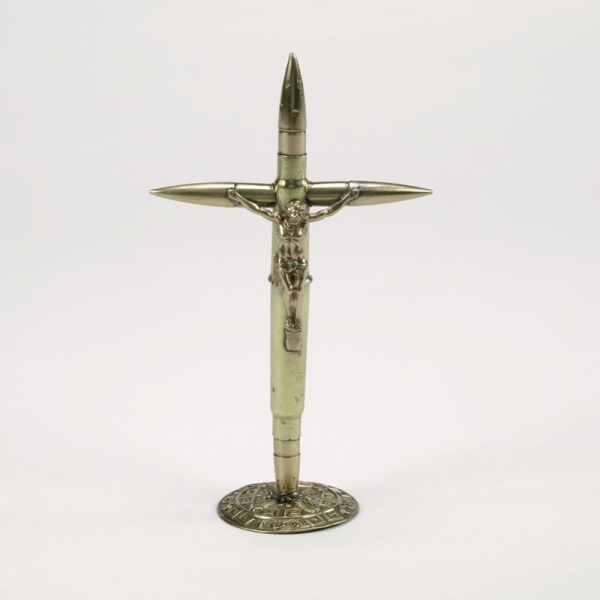
Trench art encompasses a whole range of objects made from shells, shell cases, detonators, bullets, shrapnel, and other scrap metal both during and after World War I. During the war, many of these pieces were made by off-duty soldiers as a way to fill their time and make some extra money. They fashioned items like cigarette lighters, matchbox covers, letter openers, and pens from scrap metal, sometimes personalizing them or decorating them with the insignia of regiments stationed in the area. After the war, economic deprivation, combined with the widespread availability of war débris, produced a thriving civilian trench art industry in France and Belgium. Individuals continued to produce items for sale to war widows, pilgrims, and battlefield tourists until war broke out again in 1939. 


Battlefield souvenir crucifix 
Imperial War Museums 
© IWM (EPH 1915)
Nicholas Saunders, who has written extensively about trench art, notes that the large number of soldiers declared “missing,” along with the British decision not to repatriate the dead, meant that there was a continuous stream of visitors to the old Western Front between 1919 and 1939. Many of these visitors appear to have returned home with some sort of trench art souvenir. “Such objects,” Saunders writes, “were often the only material reminder of the dead.” Widows and family members purchased trench art for a variety of reasons: “as souvenirs of a visit, as acts of worship to the deceased’s memory, and of solidarity and empathy with local people for whom their loved ones had died and whose economic hardships were everywhere apparent.” There was an additional layer of irony here, too, as many of the women who later visited the battlefields had themselves worked in the factories that produced the weapons of war.


Trench art of unknown origin and purpose
The origin and purpose of this piece of trench art from the Alice’s collection is unknown. It is made of scrap brass and a bullet, and is decorated with a German Iron Cross medal and a flattened metal disc, possibly a coin or button. It may have been intended for use as an ashtray. The nature of the item suggests that it was made by a soldier during the war, rather than as a later souvenir. It is possible that this item, like the German helmet we featured last week on our Facebook page, was brought back by local soldier Ralph Worthley Wheeler. Wheeler went to France with the 26th Engineers, which was responsible for ensuring a steady supply of clean water for soldiers and animals at the front, as well as at hospitals and encampments. He returned to the United States in June 1919 and was hospitalized in New York. He was finally discharged in January 1920, but died just a few weeks later as a result of illness acquired during his service. It is likely that his parents, Ralph and Fannie Wheeler of Chazy, donated his war souvenirs to the Alice after his death.

The meaning of trench art is ambiguous. On the one hand, the fragmented nature of the objects can be seen as reflecting the literal fragmentation of objects, landscapes, and bodies during battle. On the other hand, trench art might be looked at as an attempt to exert some kind of control over the chaos of war, by turning its débris into something useful and even beautiful. For civilians, trench art provided a link to absent loved ones, and by bringing these objects into their homes, they in a sense “domesticated” the war, making shells, bullets, and grenades an everyday part of their environment. 

Sources:

Nicholas J. Saunders, “Bodies of Metal, Shells of Memory: ‘Trench Art’ and the Great War Re-cycled,” Journal of Material Culture 5, no. 1 (March 2000): 43-67. 

Fergus Read, “Trench Art,” Imperial War Museums


Monday, April 10, 2017

The American Red Cross in the First World War

When the German Army invaded Belgium in August 1914, it sparked a massive humanitarian crisis. Hundreds of thousands of Belgian civilians were desperately in need of food, clothing, and medical care, and as the war advanced, this need extended to the occupied regions of northern France as well. Americans quickly moved to support the organizations that were formed to address the crisis. Future president Herbert Hoover first came to national attention as the chairman of the Commission for Relief in Belgium, administering the distribution of over 2 million tons of food in two years. 

Poster for Red Cross clothing drive
Also at the forefront of humanitarian aid was the American Red Cross. First established in the US in 1881, the Red Cross was still fairly small, but it was one of the few national organizations that was prepared to take on this kind of work. The ARC was able to launch a ship, the SS Red Cross, within a few weeks of the war’s outbreak, carrying medical personnel and supplies to be distributed in England France, Germany, and Russia. Although the United States was still neutral at this time, in September 1914 the ladies of West Chazy were busy making up garments from material donated by local businesses, which they sent to the American Red Cross offices in New York. 

When the US officially declared war on Germany in April 1917, the role and responsibilities of the Red Cross changed dramatically. The ARC would continue its humanitarian work with civilians in Europe, but would now also take on the responsibility of attending to the needs of American soldiers and their families both at home and overseas. In May 1917, President Woodrow Wilson appointed a War Council to direct the Red Cross and appointed New York banker Henry P. Davison as its chair.

Official Red Cross pajama pattern
Image from Unsung Sewing Patterns
Davison, with the assistance of other men from the banking and business communities, completely reorganized the Red Cross. They created 13 geographical divisions, which were further subdivided into chapters (e.g., the Plattsburgh Chapter, which encompassed all of Clinton County) and then into branches (Chazy, Champlain, Mooers, etc.). As Davison wrote, each chapter was “a complete miniature Red Cross” with its own offices and committees. The goal was, as much as possible, to standardize the production, collection, and distribution of the items being made at the local level—socks, bandages, pajamas, “comfort kits,” etc. The Red Cross issued official patterns for knitted and sewn items, and set standards for everything, down to the number of bandages that should come out of each yard of gauze.

Red Cross War Fund Week poster
In addition to producing clothing and other items for soldiers and refugees, the Red Cross raised funds to be used for war relief work. Most of this fundraising was concentrated into two “war drives,” one-week periods when Americans were urged to focus their efforts on the financial needs of the Red Cross. The Red Cross set a goal of $100 million for each drive (June 18-25, 1917 and May 20-27, 1918) and both times exceeded that goal, collecting over $283 million total.

Alice Miner played an important role in helping Chazy raise its share of the second drive’s goal. War Fund Week began with a patriotic meeting at Chazy Central Rural School, at which representatives from the chapter offices spoke about the work of the Red Cross. Three days of canvassing to collect donations followed. Alice, as head of the entertainment committee, organized a screening of the film “Rebecca of Sunnybrook Farm” at the school auditorium, and the Boys’ and Girls’ Glee Clubs performed, raising additional funds. The week culminated with a tea at Heart’s Delight, followed by a dance at Harmony Hall. Guests were free to stroll about the grounds, which were furnished with chairs and hammocks. In all, Chazy raised $1394.59 during War Fund Week in 1918.

Louise Trainer’s Red Cross Service Medal
Alice’s sister Louise Trainer must have also contributed to War Fund Week and other Red Cross activities in Chazy, because she was awarded a service medal for her work in 1918. While the higher levels of administration were mostly filled with men, at the local level, Red Cross work was largely in the hands of women like Alice and Louise. Providing medical care, clothing, and “comforts” for soldiers and their families fell within the realm of activities thought suitable for women, and many of them already had experience working with charitable, missionary, and other volunteer organizations. For people who were unable to fight due to their age or sex, the Red Cross was the ideal organization into which to channel their energy and patriotism.


Sources:

“World War I and the American Red Cross,” redcross.org

“The American Red Cross,” wwionline.org

Henry P. Davison, The American Red Cross in the Great War (New York: The Macmillan Company, 1919)


Thursday, November 10, 2016

New York State History Month: Loren Bundy’s World War I Uniform

Each November, we mark New York State History Month with a series of blog posts on items from the Alice’s collection that have a connection to the state. In 2014, we looked at early-19th century transferware depicting scenes from locations in New York State, and in 2015, our theme was items made in New York. This year, we will be featuring items associated with the military service of three New York men.


The Bundys’ cottage in Chazy
Photo from Miner Institute Archives
We begin with a uniform worn by Loren S. Bundy of Chazy during World War I. The son of Leon and Kate Bundy, Loren was born in Vermont in 1896. Around 1910, the family moved to Chazy, where Leon Bundy became the head of the construction department at Heart’s Delight Farm. Loren Bundy (then working as a bookkeeper in Hudson Falls, NY) registered for the draft in 1917 and was inducted into the army at Plattsburgh in September of that year. He then went to Camp Devens in Massachusetts for training, and arrived in France in late July 1918—just a little over three months before the end of the war. He returned to the United States in June 1919. 


Coat, breeches, puttees, and overseas cap
Service coat. Red chevron indicates honorable
discharge; lower chevron is for overseas service.
The basic components of the uniform issued to Loren Bundy and other men who served in the US Army during World War I had been developed in the early 20th century in response to changing needs and conditions that had become evident during the Spanish-American War. New materials—khaki cotton for summer and olive drab wool for winter—were introduced as well as new styles of clothing. The museum holds four pieces of Bundy’s uniform: a khaki service coat or blouse, olive drab breeches, puttees (strips of cloth that were wrapped around the lower legs), and an overseas cap. The complete uniform also would have included a shirt, campaign hat (worn in the United States but replaced in France by the overseas cap), steel helmet, trench coat, and hobnailed shoes. In addition, Bundy would have carried a haversack to hold his tent, blanket, canteen, mess kit, entrenching tool (i.e., a shovel) and other equipment. He also would have been issued a gas mask in its own bag.

Bundy would have learned how to use all this equipment, as well as his weapons, during training at Camp Devens in eastern Massachusetts. Established in 1917, Camp Devens was the primary training center for the northeast region during World War I—over 100,000 men were trained there, and another 150,000 passed through when the camp became a separation center in 1918. Camp Devens was the home of the 76th Division, made up of troops drafted mainly from New England; the division consisted of two infantry brigades, one field artillery brigade, engineers regiments, signal battalions, field hospital units, and Loren Bundy’s unit, the 301st Supply Train. He was assigned to Company B, under the command of Lieutenant John L. Fox.


Souvenir postcard folder from Camp Devens
Sylvester Benjamin Butler, a captain in the 301st, kept a scrapbook of his WWI experiences, and his family has put some of his letters and other mementos online, giving us a glimpse into life at Camp Devens and in France. (Butler also did his officer’s training at Plattsburgh.) Upon their arrival in France, the 301st was stationed in the village of St. Armand-Montrond. Butler wrote of it, “All the houses are of stone or cement, & those not right in town are of one story only beside the attic. They seem located in such higglety-pigglety fashion, which the prevalence of high walls only serves to accentuate. The people are most cordial and welcome the American troops into their homes & buildings. The men are all trying hard to get the language. We fortunately have quite a few French speakers. The little French children are delightful; they are all learning the American salute and they do like to be noticed.” Censorship regulations prevented him from describing the unit’s military activities,  but as he reminded his mother, “I don’t want you to forget if I write all about people & scenery & white cows that I’m not on a Cook’s Tour or an Agricultural Experimentation Board.”


Loren Bundy’s overseas cap with MTC insignia
Butler reported that in March 1919, part of Company B had been “sent up to Vendonne [Vendôme] on special duty as a MTC detachment with the 6th Cavalry.” The MTC, or Motor Transport Corps, was established in August 1918 to procure, record, and maintain all motorized transport for the armed forces. Loren Bundy must have been part of this group, because the insignia on his collar and overseas cap is the winged helmet of the MTC, rather than the “T” of the Artillery and Supply Trains.

By the summer of 1919, Loren Bundy and many of his fellow Clinton County servicemen were back in New York. Tucked into the pocket of his uniform was the ticket for a “Mother’s Seat” at the county’s Welcome Home Celebration, issued to Kate Bundy. This extravaganza, held in Plattsburgh on August 5, deserves a post of its own. It started with a parade in which more than 1500 returned Clinton County soldiers, marines, and sailors marched, along with Civil War and Spanish-American War veterans. They were followed by some three dozen floats constructed by towns, businesses, and organizations, which depicted everything from a Red Cross tent to a model of a NC-4 airplane large enough to hold the entire Lynch-Bourdeau Orchestra.


Advertisement from the Adirondack Record
August 1, 1919
The parade ended at the Normal School campus, where everyone assembled and local lawyer Charles J. Vert gave an address. Afterwards, the “doughboys” were served a turkey dinner, and then the crowd shifted to the barracks, where spectators had the opportunity to see several boxing and wrestling matches, as well as a baseball game between the Post team and Port Henry. In the evening, there were two concerts in downtown Plattsburgh, followed by a fireworks display and finally dancing on Clinton Street until midnight. As the Daily Press concluded its coverage, “THUS ENDED A PERFECT DAY.”

For Loren Bundy, life seemed to return to normal after the excitement of the Welcome Home Celebration. He went to live in Poughkeepsie and married Violet Mandeville, a teacher originally from Lockport, NY, and they had a son, Leon Meade Bundy. In 1931 the family returned to Clinton County, eventually settling in Plattsburgh, where Loren worked as a teller for the Plattsburgh National Bank for thirty years. In 1942, he once again registered for the draft, though at the age of 46 he was unlikely to be called into service. This time, it was his son who joined the US Navy. Loren died in 1974 at the age of 77; he and Violet are buried in Riverview Cemetery in Chazy.

Although the United States’ involvement in World War I was relatively brief, it had a lasting effect on the men who served in the military. New York sent more soldiers to fight in WWI than any other state; New Yorkers represented about 10% of all US troops. Then there were the thousands of New Yorkers who worked as nurses, as members of voluntary associations, and at home on the farms and in the factories. The many new agencies created within the federal government to address the demands of wartime would change Americans’ relationship with the state; the suffrage movement received new impetus from the involvement of women in the war; and the Great Migration of African-Americans from the south to the urban centers of the north would produce new cultural and political movements. New York State—from the city to small towns like Chazy—would play an important role in all of these changes.

Friday, July 31, 2009

The Khrabroff Collection

There is a wonderful variety of characters and historical figures to learn about at The Alice, with research frequently focusing on one General or another. On the second floor of the museum, in a little space that houses cases of dolls, is a photo of a Russian General - General Nicholas Khrabroff, who originally came to the United States from Russia as President of the Artillery Commission. From 1915-1917 the Russian Artillery Commission was based in New York, its mission to negotiate purchase of munitions and other artillery supplies for the Imperial Russian government.

The arms shortage in Russia was so acute during WWI, that by 1916 Russian soldiers were being sent to the front lines without arms, hoping they would equip themselves with weapons recovered from fallen soldiers from either side. Efforts at weapons production in Russia were greatly stepped-up and attempts to procure weapons overseas were intensified. Then came great turmoil in Russia, spurred on partly by the poor treatment of soldiers and massive loss of life in WWI.

Mrs. Khrabroff looks on as Nicholas Khrabroff puts the
finishing touches to the base of a pair of dolls.


By December, 1917 General Khrabroff was still acting in his role to procure arms, despite the changes in Government occurring in his country precipitated by the Russian Revolution. There is still question whether he could have actually been representing his government in agreements he signed during this time, having been sent as a representative of the Imperial Government, which had been overthrown in early 1917. Eventually, it became obvious that he could not return to Russia and he settled in Thetford, Vermont with his wife and daughter, having lost his son in WWI.

A Mongolian Couple and the sketches
from which Mrs. Khrabroff worked...


In their new life in Vermont it is Nicholas Khrabroff’s wife who emerges to us through her Christmas gifts to Alice. The Alice T. Miner Museum holds, among other wonderful collections, an assemblage of hand made dolls representing various historical and cultural groups of Russia. The 30 dolls, usually in male/female pairs, were lovingly made and clothed in their traditional dress by Mrs. M.V. Khrabroff, who even included accessories and jewels for the fascinating figures. Among them are: Peasant twins sent to Alice in 1929; a Polish Noble couple sent in 1928; a newly engaged Ukrainian couple; Finnish twins; a Shaman or “Mongolian Priest” holding his drum; a “bridal couple” from the Volga River region that Mrs. Khrabroff refers to as “Mordvah”, sent in 1935. The Mordvins (also Mordva, Mordvinians) are among the larger indigenous peoples of Russia.

The sketches were done by a friend in Petrograd.

Accompanying these wonderfully made dolls, some of whom have hand painted faces, are affectionate and romantic letters written to Alice by Mrs. Khrabroff about her creations. Some of the letters include sketches of costumes, and separate notes written to Alice by the dolls themselves! These letters are usually safely stored in our archives and therefore out of the public eye. Right now, however, you can see a few of the sketches and postcard images that inspired Mrs. Khrabroff, paired with the figures she created, on exhibit at The Alice.

For this pair Mrs. Khrabroff worked from postcard images...

She recreated every wonderful detail, including costume colors.

Mrs. Khrabroff once wrote to Alice, "I want you, dear Friend, to be sure that I understand very well that the only thing which makes my rag-dolls a little bit interesting and a little bit worthy (oh! very little!) to occupy a very, very small place in your beautiful and rich museum - is the truth of the costumes. Next year I am going to send you the sketches which Oksana made of the Tartars from the ethnographic figures in our best museum in Petrograd... I want that the whole Russia in the great variety of her numerous nationalities, tribes and races would stand up before you as a token of love and gratitude for what Mr. Miner and you, our endlessly kind Friend, made for one of her unfortunate families." The costumes and details of these figures are magnificent! Mrs. Khrabroff was justifiably proud of her work, and would be thrilled, we feel sure, if she knew your curiosity about these little works of art would lead you to visit The Alice!